How to Add and Subtract Hours and Minutes: Step-by-Step Guide
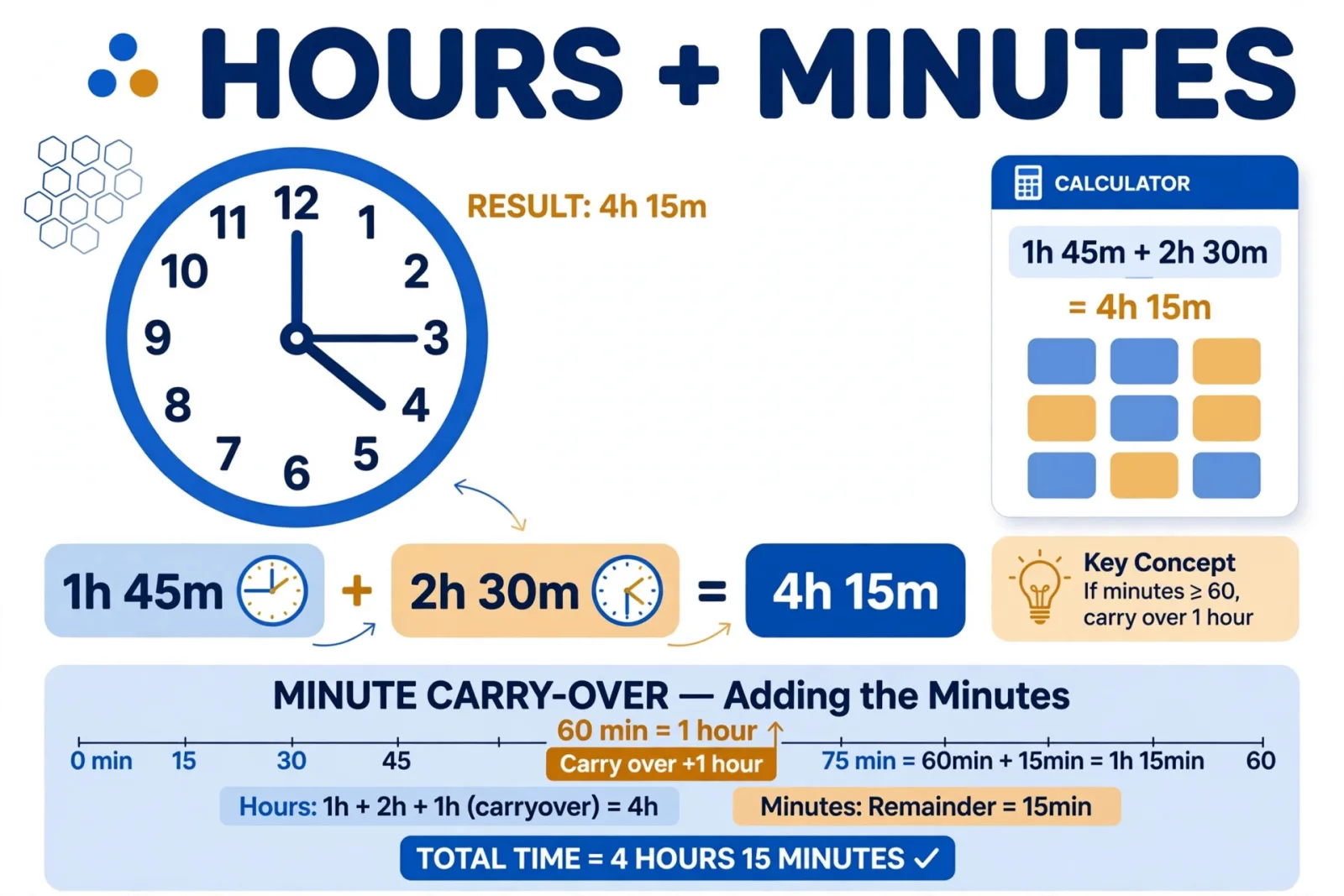
To add hours and minutes, add the hours together and the minutes together separately, then carry: every 60 minutes become 1 hour. For example, 2h 45m + 3h 30m = 5h 75m, and since 75 minutes = 1h 15m, the answer is 6h 15m. To subtract, borrow 1 hour (as 60 minutes) from the hours column when the top minutes are smaller.
On this page
Adding and subtracting hours and minutes trips up a surprising number of people — not because the math is hard, but because time doesn't follow the base-10 rules we use for everything else. An hour has 60 minutes, a minute has 60 seconds, and that one quirk is the entire key. Once you learn to carry 60 instead of 10, every duration calculation becomes simple: shift lengths, flight times, cooking times, weekly work totals.
This guide walks you through every technique, with worked examples you can check yourself. If you'd rather skip the manual math, our free hours calculator does all of this instantly — but understanding the steps will make you faster and stop costly mistakes.
The One Rule That Changes Everything: 60 Minutes = 1 Hour
Normal addition carries at 10. Time addition carries at 60. That is genuinely the whole difference.
- 45 minutes + 30 minutes = 75 minutes → but 75 minutes isn't a valid time format, so you convert: 75 − 60 = 15, and carry 1 to the hours → 1h 15m
- 90 minutes = 1h 30m. 150 minutes = 2h 30m. 60 minutes = exactly 1h 0m.
If you can divide by 60 (or just remember that 60, 120, 180 minutes = 1, 2, 3 hours), you can add any two durations.
Method 1: Add Separately, Then Carry
This is the most practical method for everyday use.
Step 1. Add the hours: hours + hours.
Step 2. Add the minutes: minutes + minutes.
Step 3. If the minutes total 60 or more, subtract 60 and add 1 to the hours. Repeat if needed.
Worked Example 1: A work shift plus overtime
You work 6h 40m and stay 2h 50m extra.
- Hours: 6 + 2 = 8
- Minutes: 40 + 50 = 90
- Carry: 90 − 60 = 30, hours become 9
- Answer: 9h 30m
Worked Example 2: Two flight legs
First leg 3h 55m, layover 1h 40m, second leg 2h 35m — total travel time?
- Hours: 3 + 1 + 2 = 6
- Minutes: 55 + 40 + 35 = 130
- Carry: 130 − 60 = 70 → carry again: 70 − 60 = 10, hours become 8
- Answer: 8h 10m
Worked Example 3: No carry needed
Cooking time 1h 15m plus resting time 0h 20m = 1h 35m. Minutes total 35, under 60 — done.
Method 2: Convert Everything to Minutes First
For some people, especially when subtracting, it's cleaner to convert each duration to total minutes, do one simple calculation, then convert back.
To convert: hours × 60 + minutes.
To convert back: divide by 60 — the whole part is hours, the remainder is minutes.
Worked Example 4: Add 2h 45m + 3h 30m this way.
- 2 × 60 + 45 = 165 minutes
- 3 × 60 + 30 = 210 minutes
- 165 + 210 = 375 minutes
- 375 ÷ 60 = 6 with remainder 15 → 6h 15m
This method shines when you're adding three or more durations or feeding numbers into a spreadsheet — and it's exactly how our hours calculator handles the math behind the scenes.
Subtracting Hours and Minutes: The Borrowing Method
Subtraction works like the addition method in reverse: when the top minutes are smaller than the bottom minutes, borrow 1 hour from the hours column and turn it into 60 minutes.
Step 1. Subtract the minutes. If the top number is smaller, borrow 1 hour (add 60 to the top minutes, subtract 1 from the top hours).
Step 2. Subtract the hours.
Worked Example 5: How long was the meeting?
It ran from 10:15 to 11:40? No — let's do a pure duration: a task was estimated at 4h 20m but finished in 1h 50m under estimate. Actual time = 4h 20m − 1h 50m.
- Minutes: 20 − 50 won't work → borrow: 20 + 60 = 80, hours drop to 3
- Minutes: 80 − 50 = 30
- Hours: 3 − 1 = 2
- Answer: 2h 30m
Worked Example 6: Exact time difference
You started at 9:05 and finished at 12:40. Elapsed = 12:40 − 9:05.
- Minutes: 40 − 5 = 35 (no borrowing needed)
- Hours: 12 − 9 = 3
- Answer: 3h 35m
Adding a Duration to a Clock Time (vs. Adding Two Durations)
These are two different operations — keep them straight:
- Duration + duration = another duration. Example: 2h 45m + 3h 30m = 6h 15m (a length of time).
- Clock time + duration = a new clock time. Example: 9:00 AM + 7h 30m = 4:30 PM (a point in time).
For clock-time addition, add hours to the clock hours and minutes to the clock minutes, carrying 60s exactly as before. Then handle AM/PM or wrap past 12/24.
Worked Example 7: A movie starts at 7:45 PM and runs 2h 35m. When does it end?
- 7:45 + 2h 35m = 9:80 → carry → 10:20 PM
- Answer: 10:20 PM
Adding Across Midnight
The trick: if the result passes 24:00 (or 12:00 AM), subtract 24 hours and note that the day changed.
Worked Example 8: You start driving at 11:30 PM and drive 2h 45m. When do you arrive?
- 11:30 PM + 2h 45m = 13:75 → carry → 14:15
- On a 24-hour clock that's 26:15? No — 23:30 + 2:45 = 26:15 → subtract 24 → 2:15 AM the next day.
A reliable way: add the minutes in total. 11:30 PM = 23:30 = 1,410 minutes after midnight. Add 165 minutes → 1,575. Subtract a full day (1,440) → 135 minutes = 2:15 AM.
Adding More Than 24 Hours
Nothing changes mathematically — durations don't wrap at 24 hours the way clock times do. You simply let the hours grow.
Worked Example 9: Two project phases take 26h 30m and 15h 50m.
- Hours: 26 + 15 = 41; minutes: 30 + 50 = 80 → carry → 42h 20m
Forty-two hours is a duration, not a clock reading, so there's no midnight wrap. Only convert to days (÷ 24) if you want a friendlier display: 42h 20m = 1 day, 18h 20m.
Decimal Hours ↔ hh:mm Conversion
Timesheets and payroll often use decimal hours (7.5 h) while people think in hh:mm (7h 30m).
Decimal → hh:mm: multiply the decimal part by 60.
- 7.75 h → 0.75 × 60 = 45 → 7h 45m
- 2.5 h → 0.5 × 60 = 30 → 2h 30m
hh:mm → decimal: divide the minutes by 60.
- 2h 20m → 2 + 20/60 = 2 + 0.333… ≈ 2.33 h
- 0h 45m → 45/60 = 0.75 h
Handy equivalents to memorize: 0.25 h = 15 min, 0.5 h = 30 min, 0.75 h = 45 min, and 0.1 h = 6 min.
Weekly Totals: Putting It All Together
Worked Example 10: A nurse works five identical shifts of 8h 15m.
- Hours: 8 × 5 = 40; minutes: 15 × 5 = 75 → carry → 41h 15m
Note how many workplaces track this as 41.25 h in payroll (15 min = 0.25 h × 5 = 1.25 h; 40 + 1.25 = 41.25). If your week's total matters for overtime — many countries cap standard full-time work around 40 hours per week — knowing the exact total is what triggers the extra pay.
5 Common Mistakes (and How to Avoid Them)
1. Carrying at 100 instead of 60. Adding 2h 50m + 1h 30m gives 3h 80m, and some people write "3.80 hours" — wrong. 80 minutes = 1h 20m, so the answer is 4h 20m.
2. Forgetting to borrow in subtraction. 4h 20m − 1h 50m is not 3h 30m (which is what you get subtracting straight down). The correct answer is 2h 30m.
3. Confusing durations with clock times. "10:30" is a time of day; "10h 30m" is a duration. Adding 10:30 + 2:00 as if they were durations gives a nonsense answer — one of them is a clock reading.
4. Dropping the AM/PM or the day change. 11:30 PM + 2h 45m = 2:15 AM, not 13:15 — always check whether you crossed midnight or noon.
5. Mixing decimal hours with minutes. 2.5 hours is 2h 30m, not 2h 50m. The decimal point is not a minutes separator.
Real-Life Uses
- Work and payroll: shift lengths, overtime, weekly totals, timesheet decimals
- Travel: flight durations, layovers, arrival times across time zones and midnight
- Cooking and baking: combining prep, cook, and rest times
- Fitness: summing workout splits, run/walk intervals, weekly training volume
- Projects and study: estimating task durations, Pomodoro blocks, exam revision plans
- Media: adding video chapter lengths, podcast runtimes, playlist totals
Frequently asked questions
How do you add hours and minutes step by step?
Add the hours separately from the minutes. Then, if the minutes total 60 or more, subtract 60 minutes and add 1 to the hours (repeat if needed). Example: 2h 45m + 3h 30m = 5h 75m → 75 − 60 = 15 → 6h 15m.
How do you subtract hours and minutes?
If the top minutes are smaller than the bottom minutes, borrow 1 hour (add 60 to the top minutes, subtract 1 from the top hours), then subtract minutes and hours normally. Example: 4h 20m − 1h 50m → borrow → 3h 80m − 1h 50m = 2h 30m.
What is 11:30 PM plus 2 hours 45 minutes?
2:15 AM the next day. 23:30 + 2:45 = 26:15; subtracting a full 24 hours gives 2:15 AM.
How do you convert decimal hours to hours and minutes?
Multiply the decimal part by 60. 7.75 h = 7h + (0.75 × 60)m = 7h 45m. To go the other way, divide the minutes by 60: 2h 20m = 2 + 20/60 = 2.33 h.
What happens if my total is more than 24 hours?
Nothing special — durations don't wrap at 24 hours. 26h 30m + 15h 50m = 42h 20m. Only convert to days if you want: 42h 20m = 1 day and 18h 20m.
Why is 2.5 hours equal to 2 hours 30 minutes and not 2 hours 50 minutes?
Because the decimal fraction is a fraction of an hour, and an hour has 60 minutes: 0.5 × 60 = 30 minutes. A decimal point is never a minutes separator in duration notation.
Related guides

How to Improve Your Typing Speed (WPM)
Learn how to improve your typing speed with home-row technique, accuracy drills, and a 2-week practice plan. Real WPM…

How to Generate Random Numbers Fairly
Learn how to generate random numbers fairly: the range formula, worked examples, no-repeat draws, and the mistakes that…

How to Change Text Case: Title Case, Sentence Case, camelCase, snake_case
Learn how to change text case: title case, sentence case, camelCase, snake_case and kebab-case, with rules, examples…

How to Convert Text to Binary and Hex: A Step-by-Step Guide with Worked Examples
Learn how to convert text to binary and hex by hand: place values, ASCII codes, UTF-8 examples and worked conversions…