How to Generate Random Numbers Fairly

A fair random number gives every number in the chosen range exactly the same chance of being picked. For a range with N possible values, each value has a probability of 1 in N. Use a trusted random number generator, fix the range before you draw, and never re-roll a result just because you dislike it — that single habit is what turns a fair draw into a rigged one.
On this page
Quick answer: A fair random number gives every number in the chosen range exactly the same chance of being picked. For a range with N possible values, each value has a probability of 1 in N. Use a trusted random number generator, fix the range before you draw, and never re-roll a result just because you dislike it — that single habit is what turns a fair draw into a rigged one.
What "fair" random really means
When people say a draw was "fair," they usually mean that nobody could predict or influence the result, and that every entry had an equal chance. In mathematics, this is called a uniform distribution: if there are N possible outcomes, each one has a probability of 1 divided by N. A fair six-sided die is the classic example. Each face — 1, 2, 3, 4, 5, 6 — has a probability of 1 in 6, or about 16.67%. No face is favored, and no face is "due" to appear.
It is important to separate fairness from pattern. A fair sequence can look uneven. If you roll a die 6 times, you will probably not see each number exactly once. If you generate 10 random numbers between 1 and 100, you may see two numbers close together, or even the same number twice. That is normal. Randomness does not mean "evenly spread out in a way that looks tidy." It means that each draw is independent and unbiased, even when the short-term results look lumpy.
Another common confusion is between random and arbitrary. Picking your favorite number, your birth year, or the first number that comes to mind is not random — it is a human choice, and human choices are full of hidden patterns. Studies of how people "pick a random number" consistently show that people avoid extremes, favor middle values, and overuse numbers like 7. If you want a fair result, do not let a person choose the number. Let a generator, a die, or a shuffled draw choose it.
The range formula: how many values, and what are the odds?
Every fair draw starts with a clearly defined range. The number of possible values in a whole-number range from a minimum to a maximum is: Count = maximum − minimum + 1. The "+ 1" matters because both endpoints are included. A range from 1 to 100 contains 100 values, not 99. A range from 5 to 15 contains 11 values (5, 6, 7, 8, 9, 10, 11, 12, 13, 14, 15), not 10. Forgetting the "+ 1" is the single most common arithmetic mistake in random draws, and it quietly changes every probability that follows.
Once you know the count N, the probability of any one specific value is: Probability = 1 in N.
Example 1: A number from 1 to 100
The count is 100 − 1 + 1 = 100. Each number has a probability of 1 in 100, which is 1%. If you run the draw 1,000 times, you would expect each number to appear about 10 times on average (1,000 divided by 100). In any single draw, though, 37 is exactly as likely as 100, and exactly as likely as 1. There is no "luckier" number in a fair draw.
Example 2: A die roll, 1 to 6
The count is 6 − 1 + 1 = 6. Each face has a probability of 1 in 6, about 16.67%. If you roll a fair die 600 times, you would expect each face about 100 times (600 divided by 6). Real rolls will deviate from 100 — perhaps one face appears 92 times and another 108 times — and that deviation does not mean the die is unfair. Only a large, systematic bias (for example, one face appearing 200 times out of 600) would suggest a problem.
Example 3: A number from 1 to 1,000
The count is 1,000 − 1 + 1 = 1,000. Each number has a probability of 1 in 1,000, which is 0.1%. This is the right scale for large raffles, prize draws with numbered tickets, and classroom activities with hundreds of participants. If only 50 tickets have been sold in a 1-to-1,000 draw, remember that 950 numbers belong to nobody — the chance that the winning number matches a sold ticket is 50 in 1,000, or 5%. The draw is still fair; it is simply a draw in which most numbers are unassigned.
A useful habit is to write the range down before generating anything: "We are drawing one whole number from 1 to 100, inclusive." That one sentence prevents the two most frequent disputes — whether the endpoints count, and whether the draw should be repeated.
No-repeat draws: raffles, seating plans, and team picks
Many real draws need several winners, and no person should win twice. That is a no-repeat draw, also called drawing without replacement. The method is simple: generate a number, remove it from the pool, and generate the next number from the smaller pool. A good random number generator has a "no repeats" or "unique numbers" option that does exactly this.
Worked example: a school raffle
Suppose a school sells 100 raffle tickets, numbered 1 to 100, and needs 3 prize winners. The fair procedure is: 1. Draw one number from 1 to 100. Say the result is 42. Ticket 42 wins the first prize. 2. Remove 42 from the pool. Draw one number from the remaining 99 tickets. Say the result is 17. Ticket 17 wins the second prize. 3. Remove 17 as well. Draw one number from the remaining 98 tickets. Say the result is 88. Ticket 88 wins the third prize.
Each ticket starts with the same chance of winning at least one prize: 3 in 100, or 3%. But once a ticket has won, it cannot win again, so the later draws are made from a smaller pool. That is fair, because every ticket faced the same rules from the start.
The same logic works for seating plans and team selection. To seat 8 people fairly, assign each person a number from 1 to 8, shuffle the order with a no-repeat draw, and seat people in the drawn order. There are 40,320 possible seating orders for 8 people (8 × 7 × 6 × 5 × 4 × 3 × 2 × 1), and a fair shuffle gives each order the same chance. What you must not do is draw an order, dislike it, and draw again until friends end up sitting together. The moment you re-draw to get a preferred outcome, the process stops being fair.
A practical tip: if you are drawing by hand, use a container with numbered slips, mix thoroughly, and draw without looking. If you are drawing on screen, use a generator with a no-repeat setting, and take a screenshot of the result before announcing it. A visible, timestamped record protects the organizer as much as the participants.
Decimal ranges: when whole numbers are not enough
Sometimes you need a random decimal — for example, a random discount between 5.00 and 20.00, or a random measurement between 1.00 and 10.00. The same fairness principle applies, but you must first decide the step size, meaning how fine the values are.
Take the range 1.00 to 10.00 in steps of 0.01. The count is (10.00 − 1.00) ÷ 0.01 + 1 = 901 values. Each value — 1.00, 1.01, 1.02, all the way to 10.00 — has a probability of 1 in 901. If you instead allow any decimal with no fixed step, the generator picks from a continuous range, and the chance of hitting one exact value becomes effectively zero; in that case, talk about ranges ("between 4.00 and 5.00") rather than exact values.
Two rules keep decimal draws fair. First, decide the step before you draw, and write it down. Second, do not round the result after the draw to make it "nicer." Rounding a drawn value of 7.38 to 7.40 changes the distribution, because some rounded values then collect results from more than one original value. If you want values rounded to one decimal place, set the generator to that step from the start.
Why random picks do NOT improve your lottery odds
This is the most persistent myth about random numbers: that a "random" set of lottery numbers is luckier than a chosen set. It is not. In a lottery where you pick 6 numbers out of 49, the number of possible combinations is 13,983,816, so any single ticket — whether its numbers came from a generator, from birthdays, or from a dream — has a probability of 1 in 13,983,816 of matching all six. The balls do not know how you chose your numbers, and the draw does not reward randomness.
There is one narrow exception, and it is about sharing a prize, not about winning one. Popular numbers (1 to 31, from calendar dates, and simple patterns like 1, 2, 3, 4, 5, 6) are chosen by many players, so if those numbers win, the jackpot is split among more winners. A random, spread-out set of numbers is less likely to be shared — but it is exactly as likely to win in the first place. So a generator can help you avoid splitting a prize; it cannot help you win one. Anyone selling a "winning random number system" is selling a story, not mathematics.
The same independence applies to streaks. If a coin has landed heads three times in a row, the probability of heads on the next flip is still 1 in 2 (three heads in a row has a probability of 1 in 8, or 12.5%, but that describes the completed sequence, not the next flip). Random events have no memory. A number that has not appeared recently is not "due," and a number that appeared yesterday is not "used up."
Common mistakes that ruin a fair draw
Re-rolling until you like the result. This is the number one fairness killer. If you generate a number, reject it, and generate again until a preferred outcome appears, the final result is no longer uniform — the numbers you dislike have been filtered out. Decide in advance: the first valid draw stands, no exceptions.
Letting a human "pick randomly." People cluster around middle values, avoid repeats, and favor familiar numbers. If a human selects the number, call it a choice, not a draw. For fairness, the selection must come from a device or process the participants cannot steer.
Changing the range mid-draw. Starting with 1 to 100 and then switching to 1 to 50 because "too many numbers are unassigned" changes every participant's odds after some have already been affected. Fix the range, the number of winners, and the no-repeat rule before the first draw, and announce them.
Using a biased tool. A cracked die, a poorly shuffled deck, or a generator that favors certain outputs all break uniformity. For casual draws, a standard die or a reputable online generator is fine. For anything involving money or prizes, use a well-known generator and keep a record of the result.
Confusing "random order" with "random selection." Shuffling a playlist and picking the first song is a fair way to pick one song. But shuffling and then skipping songs you dislike until you reach one you like is not a fair pick at all — it is a choice disguised as a shuffle.
How to run a fair draw: a short checklist
1. Write down the range, including both endpoints, before you draw. 2. State how many winners or picks you need, and whether repeats are allowed. 3. Choose the tool in advance: a fair die, shuffled slips, or a trusted random number generator with a no-repeat option if needed. 4. Make the draw visible: in person, in front of witnesses, or with a screenshot or recording. 5. Accept the first valid result. Do not re-roll, re-draw, or "do it again for luck." 6. Record the result immediately — the numbers, the date, and the witnesses — and announce it unchanged.
Follow those six steps and your draw will be fair in the sense that matters: every participant had the same chance, the process was fixed before the result was known, and nobody could steer the outcome after seeing it. That is what fairness means, and it is fully within your control — even though the result itself is not.
Frequently asked questions
What does it mean for a random number to be "fair"?
It means every number in the chosen range has exactly the same probability of being selected — a uniform distribution. For N possible values, each value has a probability of 1 in N. Fairness is about equal chances, not about results that look evenly spread.
How do I calculate the probability of one specific number?
First count the values: maximum − minimum + 1. Then the probability is 1 divided by that count. For 1 to 100, that is 1 in 100 (1%). For 1 to 6, it is 1 in 6 (about 16.67%). For 1 to 1,000, it is 1 in 1,000 (0.1%).
How do I draw several winners without anyone winning twice?
Use a no-repeat draw: after each number is drawn, remove it from the pool before drawing the next one. In a 100-ticket raffle with 3 prizes, each ticket has a 3 in 100 (3%) chance of winning at least one prize, and no ticket can win twice.
Can a random number generator improve my lottery odds?
No. In a 6-from-49 lottery, every combination has the same probability: 1 in 13,983,816. A generated set of numbers is no more likely to win than a hand-picked set. It may reduce the chance of sharing a jackpot with many other players who chose popular numbers, but it does not change the chance of winning.
Is it fair to re-roll if the result seems unlucky or boring?
No. Re-rolling until you get a result you prefer destroys uniformity, because the outcomes you reject have effectively been given a zero chance. A fair draw accepts the first valid result, even if it is inconvenient.
Why do people think a number is "due" after a long absence?
Because human intuition expects short sequences to look balanced, but random sequences do not balance themselves. Each draw is independent: past results do not change future probabilities. A number that has not appeared in a while has exactly the same chance as every other number on the next draw.
Related guides
How to Split Fair Teams in Seconds
Learn how to split fair teams fast: random draws, even and uneven groups, no-repeat rounds, and when to use a seeded…
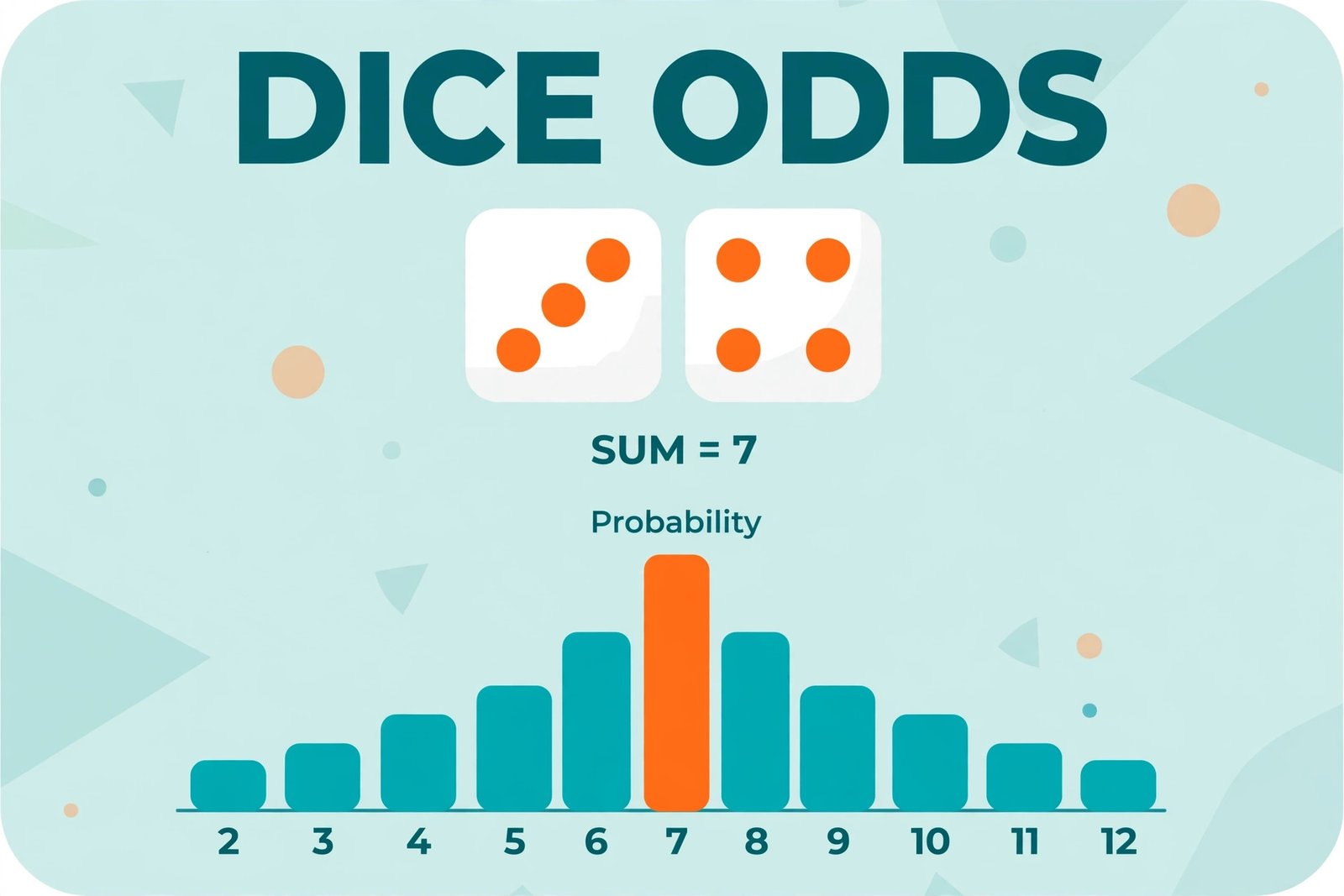
Dice Probabilities Made Simple
Learn dice probabilities the easy way: one die, two dice, why 7 is most common, and how to use the odds in board games…
How to Make Fancy Text for Bios and Posts
Learn how to make fancy text for Instagram bios, WhatsApp, Discord and TikTok using Unicode styles — plus where fancy…

How to Improve Your Typing Speed (WPM)
Learn how to improve your typing speed with home-row technique, accuracy drills, and a 2-week practice plan. Real WPM…