How to Convert Hourly Wage to Annual Salary: Formula with Examples
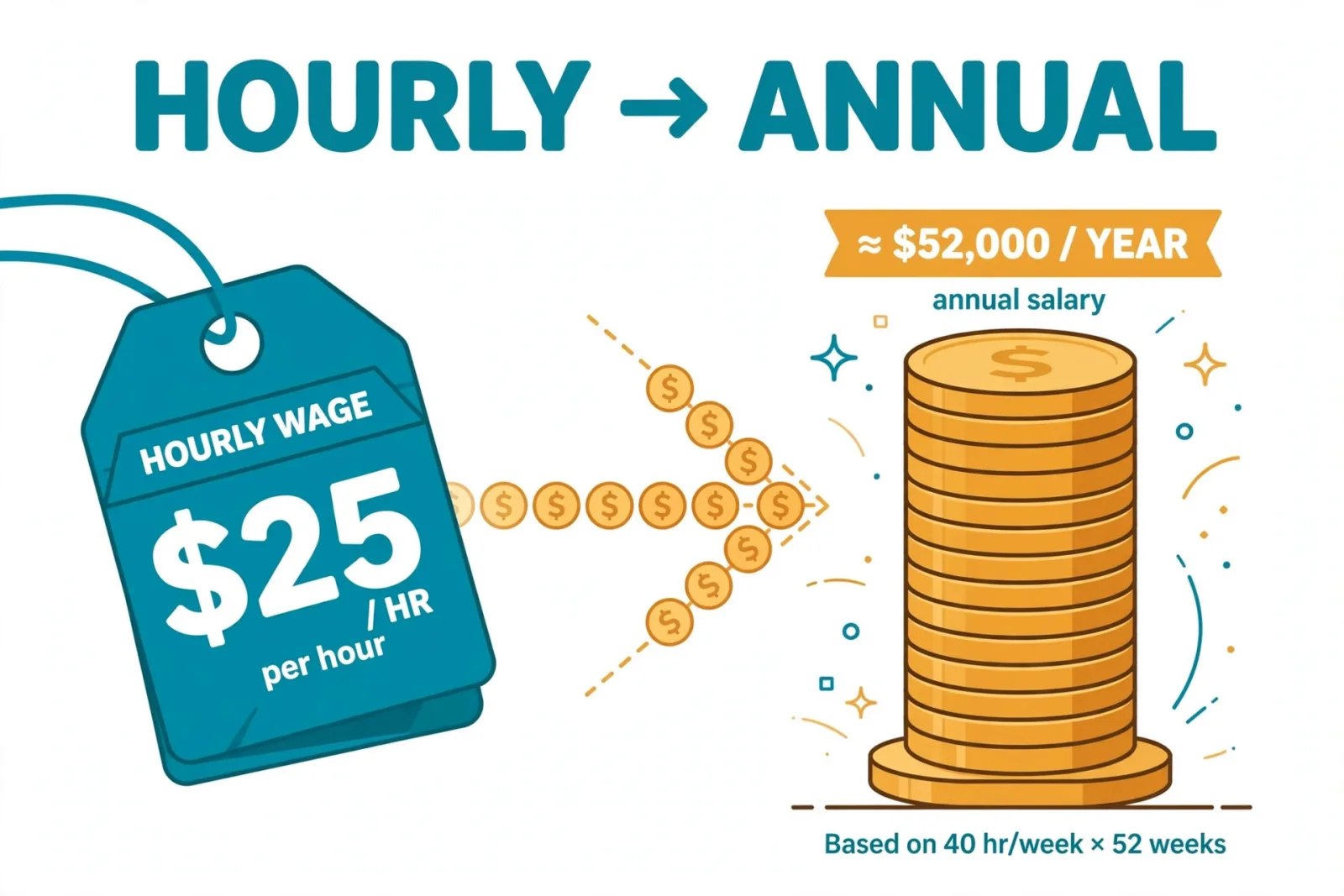
**Annual salary = hourly wage × hours worked per week × 52 weeks per year.** For example, $25/hr × 40 hours/week × 52 weeks = $52,000 per year. This is your gross (before-tax) annual pay, assuming full-time work with no unpaid time off.
On this page
Why converting your hourly wage matters
Most job offers in the United States are quoted as an hourly rate, but the big life decisions — renting an apartment, qualifying for a mortgage, setting a monthly budget, or comparing two job offers — are made in annual numbers. Knowing how to convert your hourly wage to an annual salary lets you translate "$25 an hour" into "$52,000 a year" in seconds, so you can evaluate whether an offer actually covers your bills.
It also works in the other direction. Employers frequently quote salaried roles as yearly figures, and you may want to know what that offer equals per hour before accepting. The same math answers both questions. This guide walks through the core formula step by step, adjusts it for part-time schedules, unpaid vacation, and overtime, and shows you the common mistakes people make when doing this calculation on paper.
The core formula, step by step
The formula is:
Annual salary = hourly wage × hours worked per week × weeks worked per year
For a standard full-time job in the United States, that becomes:
hourly wage × 40 hours × 52 weeks
Here is the logic broken into three steps:
Step 1 — Find your weekly pay. Multiply your hourly rate by the number of hours you work each week. At $25 an hour and 40 hours a week, that is $25 × 40 = $1,000 per week.
Step 2 — Count your paid hours per year. A full-time year is 40 hours/week × 52 weeks = 2,080 hours per year. This number is so standard that the U.S. federal government and most payroll departments use 2,080 hours as the official definition of a full-time work year.
Step 3 — Multiply. $25 × 2,080 hours = $52,000 per year. That is it — three multiplications, one reliable annual figure.
If your schedule is not 40 hours, just swap in your real weekly hours. The formula does not change, only the inputs.
Worked example: $25 an hour, full time
Let us run the complete calculation once so every step is visible:
- Hourly wage: $25
- Hours per week: 40 → weekly pay = $25 × 40 = $1,000
- Weeks per year: 52 → annual salary = $1,000 × 52 = $52,000
- Useful extras: biweekly paycheck = $52,000 ÷ 26 = $2,000; monthly budget figure = $52,000 ÷ 12 ≈ $4,333
Notice the paycheck math: most hourly workers are paid every two weeks, so dividing the annual figure by 26 pay periods gives the gross amount on each check — $2,000 in this example. The monthly figure ($4,333) is handy for budgeting even though it does not match any single paycheck.
Part-time and non-standard schedules
The same formula handles any schedule — just use your actual weekly hours.
Example 1 — Part-time at $20/hour, 25 hours a week:
$20 × 25 × 52 = $26,000 per year. This is exactly half of what a 40-hour week at the same rate would pay ($41,600), which makes sense because 25 hours is close to half of 40.
Example 2 — Four-day week at $30/hour, 32 hours a week:
$30 × 32 × 52 = $49,920 per year. Compressed schedules are increasingly common, and this shows how close a four-day week comes to a five-day one at a slightly higher rate.
Example 3 — Freelancer at $60/hour averaging 30 billable hours a week:
$60 × 30 × 52 = $93,600 per year. Freelancers should be conservative here: unpaid admin time and gaps between clients mean actual billable hours are often lower than assumed, so consider using 48 weeks instead of 52.
For part-time workers, consistency matters more than the formula. If your hours vary week to week, average the last four to six weeks and use that as your "hours per week" figure.
Subtracting unpaid time off
The 52-week version assumes you are paid for all 52 weeks. If you take unpaid vacation, unpaid sick days, or seasonal layoffs, subtract those weeks first.
Example — $25/hour, 40 hours a week, 3 weeks of unpaid vacation:
- Paid weeks: 52 − 3 = 49
- Annual pay: $25 × 40 × 49 = $49,000
Three unpaid weeks cost $3,000 at this rate — a useful number to know before planning a long trip.
Important distinction: paid time off does not change the math. If your employer pays you for two weeks of vacation and five holidays, you still earn your full 52-week figure — you simply do not have to be at work to earn part of it. Only unpaid time away reduces your annual pay.
Seasonal workers face a bigger version of this. If you work 40 hours a week for 9 months (39 weeks) at $22/hour: $22 × 40 × 39 = $34,320 per year — a very different number than the $45,760 the full-year formula would suggest.
Adding overtime to your annual figure
Overtime is usually paid at 1.5× your regular rate in the United States under the Fair Labor Standards Act, and it can materially change your annual earnings. Compute it separately, then add it to the base figure.
Example — $20/hour base, 5 overtime hours every week:
- Base pay: $20 × 40 × 52 = $41,600
- Overtime rate: $20 × 1.5 = $30/hour
- Overtime pay: $30 × 5 × 52 = $7,800 extra
- Total annual earnings: $41,600 + $7,800 = $49,400
Five extra hours a week — just one hour a day — adds nearly $8,000 to the year's earnings. That is why comparing two hourly offers by base rate alone can mislead: a lower base rate with reliable overtime can out-earn a higher base rate without it. Ask employers about typical overtime before accepting.
Gross vs. net pay: the big caveat
The formula gives you gross pay — the amount before taxes, Social Security, Medicare, health insurance premiums, and retirement contributions are taken out. Your take-home (net) pay will be noticeably lower.
As a rough rule of thumb, many U.S. workers keep about 70–80% of gross pay after taxes and deductions, but this varies enormously by state, income level, and benefits. A $52,000 gross salary might mean roughly $40,000–$44,000 in take-home pay — but you should use a paycheck calculator for your specific state rather than trusting any universal percentage.
When comparing a job offer to your current pay, compare gross to gross and net to net. Mixing the two is one of the most common sources of disappointment ("I thought $25 an hour meant $52,000 in my pocket").
The reverse formula: annual salary to hourly rate
Job shopping sometimes requires the opposite conversion. The reverse formula is:
Hourly rate = annual salary ÷ (hours per week × 52)
Example — A $60,000 salary offer for a 40-hour week:
$60,000 ÷ (40 × 52) = $60,000 ÷ 2,080 = $28.85 per hour
This is the number to compare against your current hourly wage. It also reveals a hidden cost of salaried overtime-exempt roles: if the job routinely demands 50-hour weeks, your real hourly rate is $60,000 ÷ (50 × 52) = $23.08 per hour — a 20% pay cut in disguise.
The power of a $1 raise
Small hourly raises have outsized annual effects, which is why negotiating even a dollar matters:
$1 raise × 2,080 hours = $2,080 more per year
Put differently, every extra dollar on your hourly rate is worth a little over $2,000 a year at full time. Moving from $25 to $25.50 — a "fifty-cent raise" — adds $0.50 × 2,080 = $1,040 per year, and your new annual salary is $53,040.
Use this when negotiating: asking for $2 more per hour is asking for $4,160 more per year. Employers think in annual budgets, so framing your request in yearly terms can make a modest-sounding hourly ask land with its full weight.
Common mistakes to avoid
1. Forgetting unpaid weeks. Using 52 weeks when you actually work 48 unpaid-adjusted weeks inflates your estimate by about 8%. Always subtract unpaid time.
2. Mixing gross and net. The formula outputs gross pay. If you mentally compare it to your take-home paycheck, every offer will look better than it is.
3. Using 365 days. A surprisingly common error: multiplying the hourly rate by 24 hours or by 365 days. You do not work every hour of every day — you work your scheduled weekly hours, roughly 2,080 hours per year, not 8,760.
4. Using 50 weeks "to be safe." Some guides suggest 50 weeks to account for holidays. That understates your pay if your holidays are paid — which they usually are. Use 52 and subtract only genuinely unpaid time.
5. Ignoring overtime premiums. Adding overtime at the straight hourly rate instead of 1.5× understates your earnings and weakens your negotiating position.
Quick-reference table (full-time, 40 hrs/week)
| Hourly wage | Annual salary |
|---|---|
| $15/hour | $31,200/year |
| $20/hour | $41,600/year |
| $25/hour | $52,000/year |
| $30/hour | $62,400/year |
| $50/hour | $104,000/year |
For part-time schedules, multiply the hourly rate by your actual weekly hours and then by 52 — or scale these figures proportionally (a 20-hour week pays half these amounts).
Key takeaways
- The formula: hourly wage × hours per week × 52 weeks = annual gross salary.
- The benchmark: 2,080 hours is the standard full-time work year ($1/hour = $2,080/year).
- Adjust for reality: subtract unpaid weeks, add overtime at 1.5×, and remember the result is gross pay, not take-home.
- Use it both ways: annual salary ÷ 2,080 gives your hourly equivalent — essential for comparing salaried offers.
- Try the numbers instantly with our free hourly to salary calculator.
Frequently asked questions
How do I convert my hourly wage to an annual salary?
Multiply your hourly rate by the hours you work each week, then by 52 weeks. The formula is: annual salary = hourly wage × hours/week × 52. For example, $25/hour × 40 hours × 52 weeks = $52,000 per year. This gives your gross (before-tax) annual pay.
What is $25 an hour annually?
$25 an hour equals $52,000 per year at full time (40 hours per week, 52 weeks). The math: $25 × 40 = $1,000 per week; $1,000 × 52 = $52,000. That is roughly $2,000 per biweekly paycheck before taxes and deductions.
How many working hours are in a year?
A standard full-time work year is 2,080 hours (40 hours/week × 52 weeks). This is the figure the U.S. Office of Personnel Management and most payroll systems use. If you take unpaid time off, subtract it: three unpaid weeks leaves 1,960 hours (40 × 49).
Is a $1 raise really worth $2,080 a year?
Yes, for a full-time worker. $1 × 2,080 hours = $2,080 per year. A fifty-cent raise is worth $1,040 a year, and a $2 raise is worth $4,160. This assumes you work all 52 weeks; part-time workers should multiply their raise by their own annual hours.
Should I use gross or net pay in this calculation?
Use gross pay — the hourly-to-annual formula always produces a before-tax figure. Comparing a gross annual salary to your take-home paycheck will make every offer look better than it really is. To estimate take-home pay, run your gross figure through a paycheck calculator for your state.
Does the formula include vacation and holidays?
It includes them if they are paid. The standard 52-week calculation assumes paid holidays and paid vacation do not reduce your earnings — which is true for most salaried and many hourly arrangements. If any time off is unpaid, subtract those weeks: annual pay = hourly wage × hours/week × (52 − unpaid weeks).
Related guides

How to Split Fair Teams in Seconds
Learn how to split fair teams fast: random draws, even and uneven groups, no-repeat rounds, and when to use a seeded…

Dice Probabilities Made Simple
Learn dice probabilities the easy way: one die, two dice, why 7 is most common, and how to use the odds in board games…

How to Make Fancy Text for Bios and Posts
Learn how to make fancy text for Instagram bios, WhatsApp, Discord and TikTok using Unicode styles — plus where fancy…

How to Improve Your Typing Speed (WPM)
Learn how to improve your typing speed with home-row technique, accuracy drills, and a 2-week practice plan. Real WPM…