Dice Probabilities Made Simple
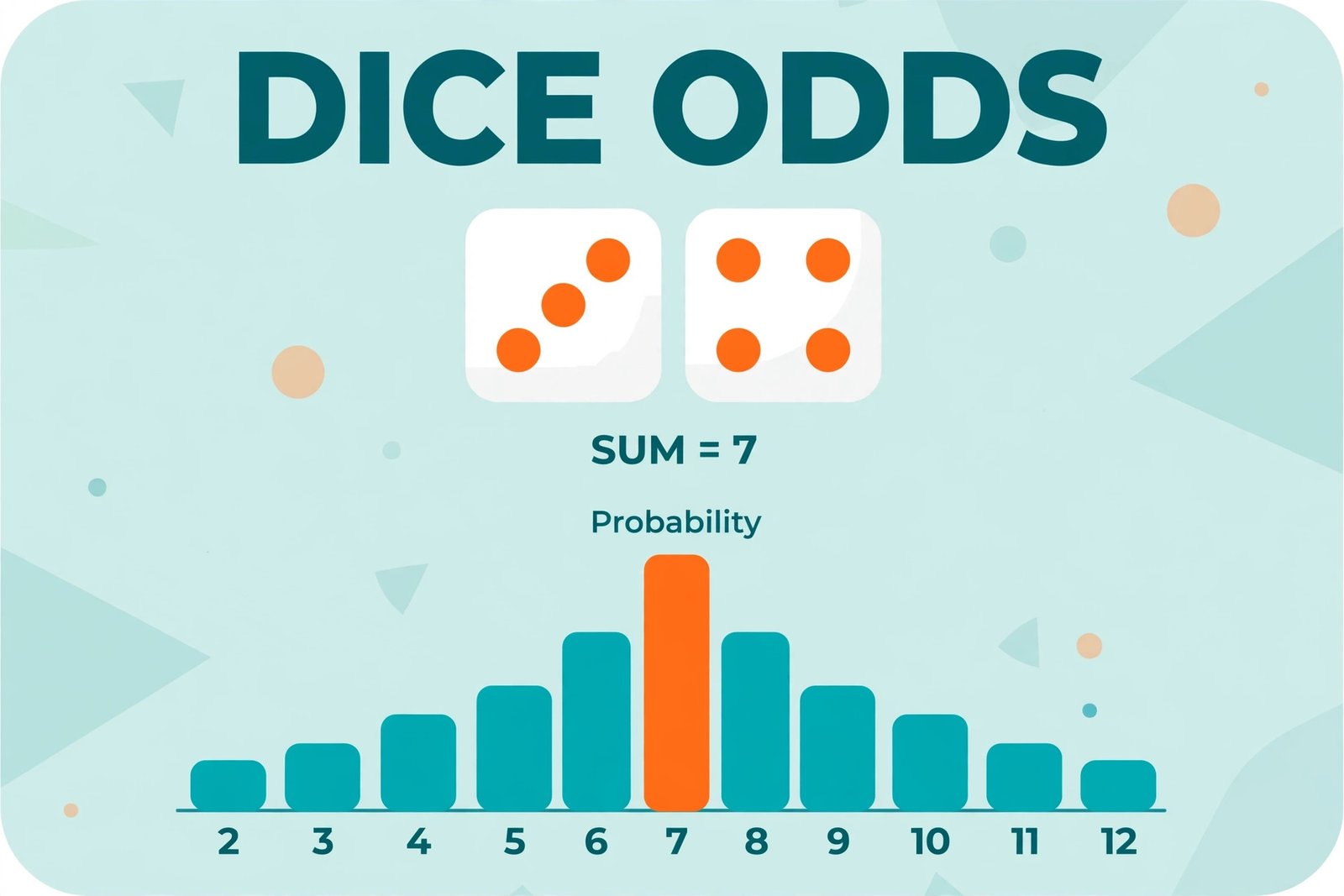
With two fair six-sided dice, 7 is the most common total: it can be made in 6 of the 36 possible combinations, so its probability is 16.67%. Totals 2 and 12 are the rarest, each with only 1 of 36 combinations (2.78%). Every other total falls in between, forming a neat pyramid shape — the closer a total is to 7, the more likely it is.
On this page
Quick answer: With two fair six-sided dice, 7 is the most common total: it can be made in 6 of the 36 possible combinations, so its probability is 16.67%. Totals 2 and 12 are the rarest, each with only 1 of 36 combinations (2.78%). Every other total falls in between, forming a neat pyramid shape — the closer a total is to 7, the more likely it is.
One die: the simplest probability in games
A standard six-sided die has six faces, numbered 1 to 6, and if the die is fair, each face is equally likely. That gives every single outcome a probability of 1 in 6, or about 16.67%. Rolling a 3 is exactly as likely as rolling a 5, a 1, or any other face. There is no face that is "due," no face that is luckier than the others, and no way to influence the result by blowing on the die, shaking it longer, or rolling it "gently." This simple fact is the foundation of everything that follows. Whenever you add a second die, you are no longer asking about one outcome out of six. You are asking about combinations — and combinations are where dice probabilities get interesting. A useful habit is to think in terms of "out of how many?" For one die, the answer is always "out of 6." For two dice, it is "out of 36," because each of the 6 faces on the first die can pair with each of the 6 faces on the second die. That single shift, from 6 to 36 possible results, explains the whole shape of two-dice probability.
Two dice: the full sums table
When you roll two dice and add them, the possible totals run from 2 (1 + 1) to 12 (6 + 6). But the totals are not equally likely, because some totals can be made in more ways than others. The table below lists every total, the combinations that produce it, and its probability.
| Total | Combinations | Count | Probability |
|---|---|---|---|
| 2 | 1+1 | 1 | 2.78% |
| 3 | 1+2, 2+1 | 2 | 5.56% |
| 4 | 1+3, 2+2, 3+1 | 3 | 8.33% |
| 5 | 1+4, 2+3, 3+2, 4+1 | 4 | 11.11% |
| 6 | 1+5, 2+4, 3+3, 4+2, 5+1 | 5 | 13.89% |
| 7 | 1+6, 2+5, 3+4, 4+3, 5+2, 6+1 | 6 | 16.67% |
| 8 | 2+6, 3+5, 4+4, 5+3, 6+2 | 5 | 13.89% |
| 9 | 3+6, 4+5, 5+4, 6+3 | 4 | 11.11% |
| 10 | 4+6, 5+5, 6+4 | 3 | 8.33% |
| 11 | 5+6, 6+5 | 2 | 5.56% |
| 12 | 6+6 | 1 | 2.78% |
Notice that the two dice are counted separately: 1+2 and 2+1 are different combinations, even though they give the same total. That is why 7 wins — it has six different routes, while 2 and 12 have only one each. Add up all the percentages and you get 100%, as you should: every roll lands on exactly one total.
Why 7 is the most common total
Think of it as a matter of room to manoeuvre. To make a 7, the first die can show almost anything — 1 through 6 — and the second die simply supplies the missing number. To make a 2, by contrast, both dice must show 1 at the same time; there is no alternative. The totals near the middle have many partner combinations, while the totals at the extremes have almost none. Plot the probabilities on a chart and you get a symmetric pyramid peaking at 7. This also explains a few handy facts. Rolling a 7 or higher happens in 21 of 36 cases, or 58.33% — more than half the time. Rolling doubles (both dice the same) happens in 6 of 36 cases, or 16.67%, exactly the same probability as rolling a 7. And the chance of rolling at least one 6 with two dice is 30.56%, because 11 of the 36 combinations contain a 6. Beginners often guess that two dice double the chance of a 6 from 16.67% to 33.33%, but the correct figure is lower, since the combination 6+6 is counted only once.
Board-game examples: why landing probabilities differ
Dice probabilities are not just theory; they change how board games play out. Consider a game where you move a token around a track, such as Monopoly or a roll-and-move race. If you are seven spaces behind a square you want to land on, you have the best possible chance of landing exactly on it — 16.67%. If you are two spaces away, your chance is only 2.78%, because only 1+1 gets you there. Two spaces behind a target is a much safer position than seven spaces behind it, and experienced players use that knowledge without thinking about it. The same logic applies in reverse. Suppose an opponent's token is a certain number of spaces behind yours and they need an exact roll to capture you. At a distance of seven, the danger is at its highest. At a distance of two or twelve, it is at its lowest. You do not need to memorize the whole table to use this: just remember that middle distances are dangerous and extreme distances are safe. Another classic example is craps, the casino dice game built entirely on these odds. The first roll, called the come-out roll, wins immediately on 7 or 11 and loses immediately on 2, 3, or 12. That is why 7 dominates the game: it appears more often than any other total, so the rules are designed around it. In family games, the same pattern appears whenever a special square, a bonus, or a penalty triggers on a particular total — the designer has, knowingly or not, chosen how often that event will happen by picking its number.
Fair-roll checks: is your die really fair?
All of the numbers above assume a fair die. A worn, chipped, or weighted die can skew the results, and a die rolled badly can too. Before trusting a die for an important game or a random draw, run these simple checks. First, look at the die. A balanced die should have opposite faces adding up to 7 (1 opposite 6, 2 opposite 5, 3 opposite 4) and pips of roughly equal depth. Casino dice take this further, with sharp edges and drilled, flush pips, precisely so that no face is heavier than another. A cheap die with deeply drilled pips on one side only can be slightly biased. Second, roll on a proper surface. A hard, flat table or a dice tray gives a clean, random tumble. Rolling in your cupped hand, on a soft bed, or down a slope can let the die slide rather than tumble, which reduces randomness. Third, roll enough times. Ten rolls prove nothing — short runs are noisy, and even a fair die can show three 6s in a row. But over 100 or more rolls, each face should appear roughly 16.67% of the time. If one face keeps dominating over a long run, retire that die.
Common misconceptions: dice have no memory
The most famous dice fallacy is the idea that a number becomes "due" after a run of other numbers. If you roll five 2s in a row, it feels as if a 6 must be coming — but the die does not remember. Each roll is independent, and the probability of a 6 on the next roll is still exactly 1 in 6, or 16.67%. Past rolls change nothing, because nothing physically changes inside the die between rolls. The mirror-image mistake is the "hot streak" belief: that a die which has just rolled several 6s is somehow more likely to roll another one. It is not. Streaks happen naturally in random sequences — in fact, in 100 rolls of a fair die you should expect some short streaks — but they carry no predictive power. The only thing that changes probabilities is changing the die, the number of dice, or the rules of the game. A related misunderstanding is confusing "unlikely" with "impossible." Rolling 2 three times in a row is rare (about 0.002% for three specific rolls), but it is not impossible, and in a long evening of play, rare events do happen. When one does, it is not proof that the dice are rigged — it is proof that you rolled a lot of dice.
A brief note on three dice
Add a third die and the same principle stretches further: there are now 6 × 6 × 6 = 216 combinations, totals run from 3 to 18, and the peak moves to 10 and 11, each with 27 combinations (12.50%). The extremes, 3 and 18, have just 1 combination each (0.46%). The pyramid becomes a bell shape, which is why games using three dice feel less swingy — middling totals dominate even more strongly. You can explore this yourself by rolling three dice and recording the totals over an evening.
How to use the dice roller for fair random picks
When you need a genuinely random result — choosing who goes first, picking a raffle winner, or settling a decision — a digital dice roller removes all doubt about fairness. There is no worn die, no sliding roll, and no argument about whether the die was cocked. Just choose the number of dice, roll, and use the result. For a fair pick among six options, number them 1 to 6 and roll one die. For a pick among 36 options, roll two dice and read them as a pair. The tool does the randomness; the probability table above tells you what to expect.
Try it
Try it: roll the dice yourself with the Dice Roller.
Frequently asked questions
What is the probability of rolling a 7 with two dice?
The probability is 6 out of 36, or 16.67%. Seven has six combinations (1+6, 2+5, 3+4, 4+3, 5+2, 6+1), more than any other total, which makes it the most common result with two six-sided dice.
What is the probability of rolling a 2 or a 12 with two dice?
Each has a probability of 1 out of 36, or 2.78%. Only 1+1 makes 2, and only 6+6 makes 12, so these are the two rarest totals. They are six times less likely than a 7.
What is the probability of rolling any single number with one die?
With a fair six-sided die, each face has a probability of 1 in 6, or 16.67%. This is true for every face, from 1 to 6, and it does not change based on previous rolls.
Why is 7 more likely than 6 or 8?
Because 7 has six combinations while 6 and 8 have five each (13.89%). Totals near the middle can be formed in more ways than totals near the edges, so the probability peaks at 7 and falls away symmetrically on both sides.
If I roll three 6s in a row, is another 6 more likely?
No. Dice have no memory, so the next roll still has a 1 in 6 (16.67%) chance of being a 6. Streaks are a normal feature of random sequences and do not make any outcome "due" or "hot."
What is the probability of rolling doubles with two dice?
Doubles occur in 6 of 36 combinations (1+1, 2+2, 3+3, 4+4, 5+5, 6+6), giving a probability of 16.67% — the same as rolling a 7.
What are the most common totals with three dice?
With three dice, totals 10 and 11 are tied as the most common, each with 27 of 216 combinations (12.50%). The rarest totals are 3 and 18, each with just 1 combination (0.46%).
How can I make a fair random choice with dice?
Number your options 1 to 6 and roll one die, or use an online dice roller for a provably random result. Avoid worn or chipped dice, roll on a flat surface, and let the die tumble freely rather than sliding it.
Sources
- Wikipedia, "Dice" — https://en.wikipedia.org/wiki/Dice
- Encyclopaedia Britannica, "Dice" — https://www.britannica.com/topic/dice
- Random.org, Dice Roller — https://www.random.org/dice/
Frequently asked questions
What is the probability of rolling a 7 with two dice?
The probability is 6 out of 36, or 16.67%. Seven has six combinations (1+6, 2+5, 3+4, 4+3, 5+2, 6+1), more than any other total, which makes it the most common result with two six-sided dice.
What is the probability of rolling a 2 or a 12 with two dice?
Each has a probability of 1 out of 36, or 2.78%. Only 1+1 makes 2, and only 6+6 makes 12, so these are the two rarest totals. They are six times less likely than a 7.
What is the probability of rolling any single number with one die?
With a fair six-sided die, each face has a probability of 1 in 6, or 16.67%. This is true for every face, from 1 to 6, and it does not change based on previous rolls.
Why is 7 more likely than 6 or 8?
Because 7 has six combinations while 6 and 8 have five each (13.89%). Totals near the middle can be formed in more ways than totals near the edges, so the probability peaks at 7 and falls away symmetrically on both sides.
If I roll three 6s in a row, is another 6 more likely?
No. Dice have no memory, so the next roll still has a 1 in 6 (16.67%) chance of being a 6. Streaks are a normal feature of random sequences and do not make any outcome "due" or "hot."
What is the probability of rolling doubles with two dice?
Doubles occur in 6 of 36 combinations (1+1, 2+2, 3+3, 4+4, 5+5, 6+6), giving a probability of 16.67% — the same as rolling a 7.
What are the most common totals with three dice?
With three dice, totals 10 and 11 are tied as the most common, each with 27 of 216 combinations (12.50%). The rarest totals are 3 and 18, each with just 1 combination (0.46%).
How can I make a fair random choice with dice?
Number your options 1 to 6 and roll one die, or use an online dice roller for a provably random result. Avoid worn or chipped dice, roll on a flat surface, and let the die tumble freely rather than sliding it.
Related guides

How to Make Fancy Text for Bios and Posts
Learn how to make fancy text for Instagram bios, WhatsApp, Discord and TikTok using Unicode styles — plus where fancy…

How to Improve Your Typing Speed (WPM)
Learn how to improve your typing speed with home-row technique, accuracy drills, and a 2-week practice plan. Real WPM…

How to Generate Random Numbers Fairly
Learn how to generate random numbers fairly: the range formula, worked examples, no-repeat draws, and the mistakes that…
How to Change Text Case: Title Case, Sentence Case, camelCase, snake_case
Learn how to change text case: title case, sentence case, camelCase, snake_case and kebab-case, with rules, examples…