How to Split Fair Teams in Seconds
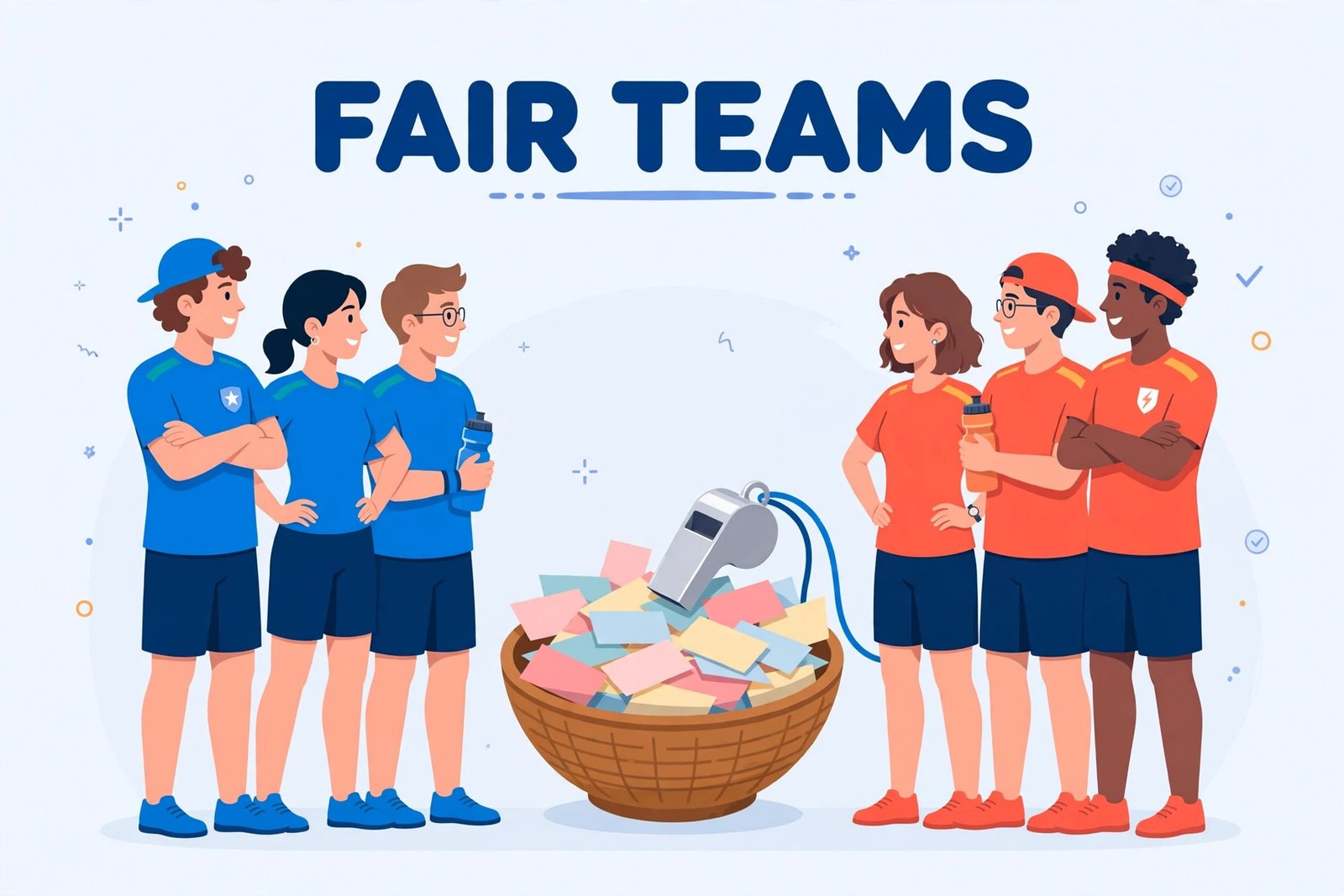
To split fair teams in seconds, shuffle the full list of names once and deal people off the top into teams in turn — that gives every person an equal chance of landing on any team. If the numbers do not divide evenly, keep team sizes within one of each other (for example, 23 players become teams of 6, 6, 6 and 5) rather than leaving one tiny team. Random draws are fair when everyone is roughly equal, but when skill levels differ widely, use a seeded or snake draft instead so the teams end up balanced as well as random.
On this page
What "fair" really means when you split teams
People use the word "fair" to mean two different things, and confusing them is the most common reason a team split feels wrong afterwards. The first meaning is equal chance: nobody was favoured or punished by the method. A random draw is fair in this sense. Nobody can complain that the teacher or captain picked favourites, because nobody picked at all. The second meaning is equal strength: the teams are evenly matched, so the game or task is competitive. A random draw does not guarantee this. If the two best players in a class happen to land on the same side, that team will probably win — even though the draw itself was perfectly honest. Before you split anyone, decide which kind of fairness matters for your situation. A quick lunchtime game? Equal chance is enough. A tournament, a graded class activity, or a match people care about? You need equal strength too, and this guide shows you how to get it.
How random team assignment actually works
A proper random split has two steps, and the order matters. Step 1: Shuffle the whole list. Put every name in a random order. The standard method is the Fisher-Yates shuffle: walk down the list and swap each name with another name chosen at random from the ones not yet placed. Done correctly, every possible ordering of the names is equally likely. This is the same idea behind shuffling a deck of cards. Step 2: Deal people into teams in turn. Take the shuffled list and hand out names one at a time: first name to Team A, second to Team B, third to Team C, back to Team A, and so on. Alternatively, cut the shuffled list into blocks: the first 6 names form Team 1, the next 6 form Team 2. Both methods give the same result — every person has an equal chance of ending up on any team. What you must not do is shuffle badly. Sorting names alphabetically and cutting the list in half is not random — it groups siblings and friends with similar surnames together. Drawing names from a hat one at a time works, but only if you genuinely mix the hat before every draw; pulling names from the top of an unmixed pile is just the original order in disguise. A random team generator tool does steps 1 and 2 for you instantly, which is why it beats doing it by hand for a large group.
Try it with a small group
Take 10 friends and split them into two teams of 5. Shuffle the 10 names, then deal them alternately: positions 1, 3, 5, 7 and 9 form one team, positions 2, 4, 6, 8 and 10 the other. There are 252 ways to choose 5 people from 10, and the shuffle gives each of them an equal chance. Nobody can argue with the result, because nobody chose it.
Even groups: the easy case
When the number of people divides exactly by the number of teams, the method above is all you need. Worked example — a class of 24 students into 4 teams of 6. Shuffle all 24 names. The first 6 names are Team 1, the next 6 are Team 2, then Team 3, then Team 4. Every team has exactly 6 students, and every student had the same chance of joining any team. If you want team names, assign them after the split — never before, or people will ask to swap into the team with the best name. Worked example — 20 football players into 2 teams of 10. Shuffle the 20 names and deal alternately, or cut the list after 10. Either way, each team has 10 players: a goalkeeper plus 9 outfield players, or whatever formation your game uses. With 20 players there are 92,378 different ways to split into two teams of 10, so a random draw will almost never repeat a previous split exactly.
Uneven groups: handling the remainder
Real life rarely divides neatly. The rule for uneven groups is simple: team sizes must differ by at most one. Never leave one team much smaller than the rest, because the small team will feel punished — and in a game, it usually loses. There are three ways to handle a remainder, and the right one depends on your situation.
Method 1: One team is one player short
Divide as evenly as possible and let the last team be smaller by one. Worked example — 23 students into 4 teams. 23 divided by 4 is 5 with a remainder of 3, so the fair split is 6, 6, 6 and 5. Three teams have 6, one team has 5. Nobody is more than one player away from anyone else.
Method 2: Spread the remainder across teams
If you need a specific number of teams, spread the extra players one per team instead of dumping them all on one team. Worked example — 17 players into 3 teams. 17 divided by 3 is 5 with a remainder of 2, so the split is 6, 6 and 5. The two extra players go to two different teams, not both to the same team. Worked example — 11 players into 2 teams. The split is 6 and 5. The team of 6 has one substitute or rotates a player off; in a classroom task, the team of 6 simply has one extra pair of hands.
Method 3: Change the number of teams
Sometimes the kindest fix is to change how many teams you make. Worked example — 26 players who wanted teams of 6. Dividing by 6 gives four teams of 6 plus a leftover team of 2 — a team of 2 is not a team at all. Instead, make 4 teams of 7, 7, 6 and 6. Every team is close in size, and nobody is stranded in a pair. Similarly, 7 players who wanted two teams become teams of 4 and 3, not 5 and 2. The pattern to remember: when the remainder would leave a team of 1 or 2, change the team count. When the remainder is small, spread it so sizes differ by at most one.
Avoiding repeat pairings across rounds
In a PE lesson or a games night, you often split the same group several times. If you shuffle fresh every round, some people will keep meeting as teammates purely by chance, while others never play together. A no-repeat draw fixes that. The trick is to track pairs, not just teams. After round one, write down who shared a team with whom. In round two, shuffle again, but if the draw puts two previous teammates together, swap one of them with a player from another team. Keep a simple list: each person's previous teammates are off-limits for the next round. How far can you go? With 12 people in teams of 4, each person has 3 teammates per round and 11 other people to meet, so you can manage 3 full rounds in which nobody repeats a teammate (3 x 3 = 9 teammates met, with 2 people still unmet). By round four, at least one repeat becomes unavoidable — and that is fine. The goal is not zero repeats forever; it is fewer repeats than blind chance would give you. For a classroom, the same idea works across a term: rotate project groups each month and keep a list of who has already worked together, so every student collaborates with new classmates over the year.
When random teams are unfair: the skill problem
Random draws are honest, but honesty is not the same as balance. Imagine a class football game where the two strongest players both land on Team A. Team A wins 8-1, Team B stops trying, and everyone says the split was "unfair" — even though the draw was random. The complaint is really about strength, not chance. Warning signs that a random split will feel unfair: a few players are far stronger than the rest (a school team player among beginners); the group is small, so one star player swings the whole balance; the result matters — a tournament, a grade, or a prize. In these cases, do not use a pure random draw. Use one of the methods below instead. They keep an element of chance while making the teams genuinely competitive.
Fix 1: The seeded draft
Rank the players from strongest to weakest, then deal them like cards in a snake pattern: the best player goes to Team A, the next two to Team B and Team A, and so on, reversing direction each round. This is called a snake draft because the pick order zig-zags: A, B, B, A, A, B, B, A. Worked example — 12 ranked players into 2 teams. Rank the players 1 (best) to 12. The snake draft gives Team A the players ranked 1, 4, 5, 8, 9 and 12, and Team B the players ranked 2, 3, 6, 7, 10 and 11. Add up the ranks: Team A totals 39 and Team B totals 39 — exactly equal. That is the beauty of the snake draft: with an even number of rounds, the two teams' total rankings balance out almost perfectly.
Fix 2: Captain picks with a twist
Let two captains take turns picking players, but make the weaker captain pick first, or give the first pick to the captain whose team lost last time. Alternating picks naturally spread talent, because each captain grabs the best available player on their turn. To keep it friendly, have captains pick privately (by pointing or by list) rather than calling names out loud in front of everyone — being picked last in public is miserable, and a good split should never embarrass anyone.
Fix 3: Tiered random draw
If full ranking feels too serious, split players into broad tiers instead — for example, "confident", "average" and "beginner" — then draw randomly within each tier. Each team gets a random mix from every tier, so no team ends up with all the beginners or all the stars, but nobody is publicly ranked 1 to 20 either. This is the best option for school classes and casual clubs: it is fast, it feels fair, and it protects everyone's dignity.
Probability intuition: will two friends end up together?
People often ask what the odds are that two specific people land on the same team. The answer is surprisingly high, and the formula is simple: Chance two specific people share a team = (team size - 1) / (total people - 1). Why? Once the first person is placed, there are (total - 1) remaining spots, and (team size - 1) of them are on that person's team.
| People | Teams | Chance two friends share a team |
|---|---|---|
| 10 people | 2 teams of 5 | 4/9 = 44.4% |
| 20 people | 2 teams of 10 | 9/19 = 47.4% |
| 12 people | 3 teams of 4 | 3/11 = 27.3% |
| 16 people | 4 teams of 4 | 3/15 = 20.0% |
| 24 people | 4 teams of 6 | 5/23 = 21.7% |
| 30 people | 2 teams of 15 | 14/29 = 48.3% |
Notice the pattern: with only two teams, two friends have nearly a coin-flip chance of being together. With four or more teams, the chance drops below a quarter. So if two best friends really want to play together, a random draw into two big teams gives them a good shot — but never a guarantee. And if you are trying to separate two disruptive students, a random draw into four teams only gives you about a 78% chance of success, so you may want to place them deliberately instead.
Common mistakes to avoid
- Letting people choose their own teams: friends cluster together, the last few picked feel rejected, and the teams are almost never balanced.
- Splitting by obvious traits: boys versus girls, or one class versus another, bakes in imbalance and resentment.
- Re-drawing until you "like" the result: if you shuffle again because the first draw looked uneven, you are no longer being random — you are hand-picking with extra steps, and people will notice.
- Forgetting the remainder: announcing "teams of 6" for 26 people and then improvising a team of 2 at the end is the fastest way to ruin the activity.
- Announcing ranks in public: rankings are a tool for balancing, not a leaderboard. Keep them private.
The 30-second checklist
- Count your people and decide how many teams you need.
- Decide: does equal chance suffice, or do you need equal strength too?
- Shuffle the full list once (or use ToolFacil's free team generator: https://toolfacil.com/team-generator/).
- Deal names in turn, keeping team sizes within one of each other.
- If you play multiple rounds, track previous teammates to avoid repeats.
- If skill gaps are large, use a snake draft or tiered draw instead of pure chance.
Split this way, and the teams are fair, the result is defensible, and you spent seconds — not twenty minutes of arguing — getting there.
Frequently asked questions
How do you split an odd number of people into teams?
Divide as evenly as possible so team sizes differ by at most one. For 23 people into 4 teams, use 6, 6, 6 and 5. For 11 people into 2 teams, use 6 and 5. If the remainder would leave a team of 1 or 2, change the number of teams instead — for example, 26 people become 4 teams of 7, 7, 6 and 6 rather than four teams of 6 plus a pair.
What is the fairest way to split teams?
It depends on the group. For players of similar ability, a random shuffle-and-deal draw is fairest because nobody can accuse anyone of favouritism. For groups with big skill gaps, a snake draft or tiered random draw is fairer because it balances strength as well as chance. The least fair method is letting people pick their own teams.
How does a random team generator work?
It shuffles the list of names using a random algorithm — usually the Fisher-Yates shuffle, which gives every possible ordering an equal chance — and then deals the shuffled names into teams in turn. Good generators also handle remainders, keeping team sizes within one of each other, and some let you exclude previous pairings for repeat rounds.
What is a snake draft?
A snake draft is a picking order that reverses each round: with two teams, the order is A, B, B, A, A, B, B, A. Because the team that picks last in one round picks first in the next, the talent evens out. With 12 players ranked 1 to 12, a snake draft gives both teams a total rank of 39 — exactly equal.
How do you stop the same people being on a team every time?
Keep a list of who has shared a team with whom, and when you draw the next round, swap out any repeat pairing. With 12 people in teams of 4, you can manage 3 full rounds without anyone repeating a teammate, since each person meets 3 new teammates per round out of 11 other people. After that, some repeats become mathematically unavoidable.
What is the probability that two friends end up on the same team?
Use (team size - 1) / (total people - 1). In a group of 20 split into two teams of 10, the chance is 9/19, about 47.4% — nearly a coin flip. In a group of 16 split into four teams of 4, it is 3/15, exactly 20%. The more teams there are, the lower the chance.
Should captains pick teams?
Captain picks work well when captains alternate and the first pick goes to the weaker side, because talent spreads naturally. They work badly when picks are called out in public, because being picked last is embarrassing. For school and casual settings, a private or tiered draw is kinder and usually just as balanced.
Related guides
Dice Probabilities Made Simple
Learn dice probabilities the easy way: one die, two dice, why 7 is most common, and how to use the odds in board games…
How to Make Fancy Text for Bios and Posts
Learn how to make fancy text for Instagram bios, WhatsApp, Discord and TikTok using Unicode styles — plus where fancy…

How to Improve Your Typing Speed (WPM)
Learn how to improve your typing speed with home-row technique, accuracy drills, and a 2-week practice plan. Real WPM…

How to Generate Random Numbers Fairly
Learn how to generate random numbers fairly: the range formula, worked examples, no-repeat draws, and the mistakes that…