How to Read Military Time: Convert Military Time to Standard Time
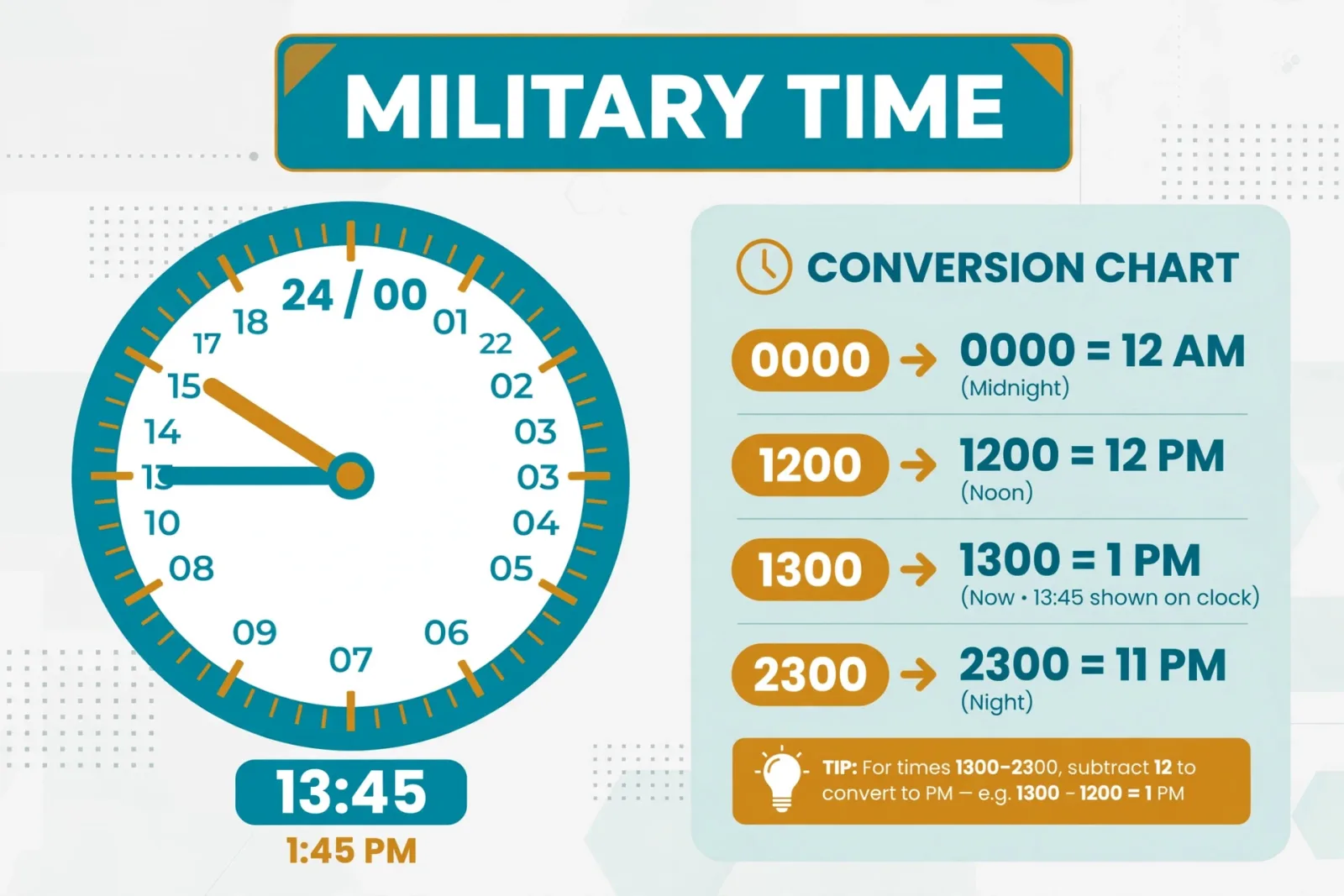
**Military time is a 24-hour clock written as four digits with no colon** — the first two digits are the hour (00–23) and the last two are the minutes. **To convert: 0000 is midnight (12:00 AM), 1200 is noon (12:00 PM), hours 01–11 stay the same with AM, and hours 13–23 subtract 12 and add PM.** For example, 1345 − 12 = 1:45 PM.
### What is military time? Military time is a timekeeping system based on the **24-hour clock**. Instead of splitting the day into two 12-hour halves with AM and PM, it counts the hours of the day continuously from **00 to 23**. Midnight is the start of the day and is written as **0000** (pronounced "zero hundred hours"). Three formatting rules distinguish military time from the standard 12-hour clock: 1. **Always four digits.** Hours are padded with a leading zero, so 7:30 AM is written as **0730**, never 730. 2. **No colon.** The colon between hours and minutes is dropped: 0730, not 07:30. 3. **No AM or PM.** The hour itself tells you which half of the day it is, so AM and PM are unnecessary. Because the system leaves no room for AM/PM confusion, a time like "8:00" can never be mistaken for "8 AM vs. 8 PM". That precision is exactly why it was adopted by organizations where a scheduling mistake can be dangerous. ### How to read any 4-digit military time Reading military time is simple once you know the pattern. Take the four digits and split them in half: **HHMM → HH = hours (00–23), MM = minutes (00–59)** - **0730** → hours = 07, minutes = 30 → 7:30 in the morning - **1845** → hours = 18, minutes = 45 → 6:45 in the evening - **0005** → hours = 00, minutes = 05 → 12:05 AM (just after midnight) - **1205** → hours = 12, minutes = 05 → 12:05 PM (just after noon) You read it in one smooth motion: hours first, then minutes. The leading zero is not optional — it is what makes the four-digit pattern work. ### Converting military time to standard 12-hour time To convert military time back to the standard 12-hour clock, there are only four cases to remember: | Military hours | Rule | Example | |---|---|---| | **0000** | Midnight → **12:00 AM** | 0000 = 12:00 AM | | **01–11** | Same number, add **AM** | 0730 = 7:30 AM | | **1200** | Noon → **12:00 PM** | 1200 = 12:00 PM | | **13–23** | Subtract 12, add **PM** | 1345 → 1:45 PM | The mnemonic is simple: **if the hour is greater than 12, subtract 12 and say PM.** 1300 → 1:00 PM, 1700 → 5:00 PM, 2215 → 10:15 PM. If the hour is 12 or below, it works the same as the regular clock, except 0000 becomes 12:00 AM and 1200 becomes 12:00 PM. ### Full military-to-standard conversion chart Here is the complete 24-hour chart, one row per hour, with the standard spoken pronunciation: | Military | Standard | Pronunciation | |---|---|---| | 0000 | 12:00 AM (midnight) | zero hundred hours | | 0100 | 1:00 AM | oh-one hundred hours | | 0200 | 2:00 AM | oh-two hundred hours | | 0300 | 3:00 AM | oh-three hundred hours | | 0400 | 4:00 AM | oh-four hundred hours | | 0500 | 5:00 AM | oh-five hundred hours | | 0600 | 6:00 AM | oh-six hundred hours | | 0700 | 7:00 AM | oh-seven hundred hours | | 0800 | 8:00 AM | oh-eight hundred hours | | 0900 | 9:00 AM | oh-nine hundred hours | | 1000 | 10:00 AM | ten hundred hours | | 1100 | 11:00 AM | eleven hundred hours | | 1200 | 12:00 PM (noon) | twelve hundred hours | | 1300 | 1:00 PM | thirteen hundred hours | | 1400 | 2:00 PM | fourteen hundred hours | | 1500 | 3:00 PM | fifteen hundred hours | | 1600 | 4:00 PM | sixteen hundred hours | | 1700 | 5:00 PM | seventeen hundred hours | | 1800 | 6:00 PM | eighteen hundred hours | | 1900 | 7:00 PM | nineteen hundred hours | | 2000 | 8:00 PM | twenty hundred hours | | 2100 | 9:00 PM | twenty-one hundred hours | | 2200 | 10:00 PM | twenty-two hundred hours | | 2300 | 11:00 PM | twenty-three hundred hours | For times that are not on the hour, read the minutes digit by digit after the hour: 1345 is "thirteen forty-five", and 2015 is "twenty fifteen". Times ending in "hundred" are always exact hours. ### Worked conversion examples **Example 1 — 0730 → 7:30 AM.** The hour 07 is between 01 and 11, so the rule says: same number, add AM. 07 = 7, minutes = 30 → **7:30 AM**. **Example 2 — 0000 → 12:00 AM.** The hour is 00, which is the special midnight case. The day restarts at 0000, and on the 12-hour clock that moment is **12:00 AM**. **Example 3 — 1200 → 12:00 PM.** The hour is 12, the special noon case. On the 12-hour clock, the middle of the day is **12:00 PM**. **Example 4 — 1345 → 1:45 PM.** The hour 13 is greater than 12, so subtract 12: 13 − 12 = 1, then add PM. Minutes stay 45 → **1:45 PM**. **Example 5 — 2215 → 10:15 PM.** The hour 22 is greater than 12, so subtract 12: 22 − 12 = 10, then add PM. Minutes stay 15 → **10:15 PM**. **Example 6 — 2359 → 11:59 PM.** The hour 23 is greater than 12, so subtract 12: 23 − 12 = 11, then add PM. Minutes stay 59 → **11:59 PM**. This is the last minute of the day — one minute later, the clock rolls over to 0000. ### Midnight edge cases: 0000 vs. 2400 You will occasionally see midnight written as **2400**. Technically, **0000** means the *start* of a day and **2400** means the *end* of a day — they describe the same moment from different directions. In practice, 2400 is rarely used and is discouraged because it creates confusion ("does 2400 belong to today or tomorrow?"). The safe convention: **use 0000 for midnight**, and let the next minute be 0001. If you see 2400 in an old schedule or a timetable, read it as midnight at the end of that day — equivalent to 0000 of the following day. ### How to pronounce military time Military time is spoken aloud using specific conventions: - **Hours 01–09:** say "oh" before the hour. 0730 is "oh-seven-thirty". Minutes below 10 are also read with "oh": 0735 can be "oh-seven-thirty-five" or "oh-seven-three-five" — both are understood. - **Exact hours:** add the word "hundred". 1300 is "thirteen hundred hours", 0900 is "oh-nine hundred hours", 1800 is "eighteen hundred hours". - **Minutes after the hour:** read them as a number. 2015 is "twenty fifteen", 1345 is "thirteen forty-five", 0020 is "zero zero twenty". - **The word "hours":** on-the-hour times are often followed by the word "hours" in spoken military contexts ("report at fifteen hundred hours"), but it is dropped in casual use ("fifteen hundred" or "thirteen forty-five"). ### Zulu time (UTC) — a quick note In military and aviation contexts you may see times with a **Z** suffix, like **1345Z**. The Z stands for **Zulu time**, the phonetic-alphabet word for Z, which marks the time zone of the prime meridian: **Coordinated Universal Time (UTC)**. 1345Z means 1:45 PM UTC. Using a single global reference time avoids the chaos of coordinating operations across time zones, which is exactly why the military relies on it. ### Who uses military time? The 24-hour military format is the standard time system for: - **Armed forces** of most countries — the origin of the name. - **Aviation** — flight plans, air traffic control, and pilot briefings all use 24-hour time, often in Zulu time. - **Hospitals and emergency services** — where a misread AM/PM on a medication or dispatch order can cost lives. - **Railways and public transport** — most train schedules in Europe and Asia use 24-hour time. - **NASA and space agencies** — mission timelines are tracked in 24-hour format. - **Emergency management and police** — incident reports use it for unambiguous timestamps. Much of the world also uses 24-hour time in daily life, usually with a colon (19:45), which is the same system with slightly different formatting. ### Common mistakes to avoid **1. Calling 1200 "12 AM".** 1200 is noon — **12:00 PM**. This is the single most common military-time mistake. Remember: 0000 is midnight (AM), 1200 is noon (PM). **2. Dropping the leading zero.** Writing **730** instead of **0730** breaks the four-digit pattern and invites misreading. Always write the leading zero: 0730, 0905, 0015. **3. Adding a colon.** Military time has no colon — **0730**, not 07:30. (The colon version is the civilian 24-hour clock, a different formatting convention.) **4. Confusing 0030 with 0300.** Digits are read positionally: in 0030 the hour is 00 (midnight) and the minutes are 30 → **12:30 AM**. In 0300 the hour is 03 → **3:00 AM**. Swapping the pairs gives a completely different time. **5. Saying "hundred" with minutes.** "Thirteen hundred" means exactly 1300. If there are minutes, never say hundred — 1345 is "thirteen forty-five", not "thirteen hundred forty-five". **6. Forgetting to subtract 12.** 1745 is 5:45 PM (17 − 12 = 5), not 7:45 PM. For any hour above 12, subtract 12 and add PM. ### Key takeaways - **Military time = 24-hour clock, four digits, no colon, no AM/PM** — HHMM, with the hour ranging 00–23. - **Convert with four rules:** 0000 = 12:00 AM (midnight), 01–11 = same number AM, 1200 = 12:00 PM (noon), 13–23 = subtract 12 → PM. - **Pronounce with "oh" for single digits and "hundred" for exact hours** — 0730 is "oh-seven-thirty", 1300 is "thirteen hundred hours". - **Use 0000 for midnight**, not 2400; and remember 1200 is noon (PM), not midnight. - Convert any time instantly with our free [military time converter](/military-time-converter/).
Frequently asked questions
How do you read military time?
Split the four digits in half: the first two are the hour (00–23) and the last two are the minutes. For example, 1845 has hour 18 and minutes 45, which is 6:45 in the evening. Leading zeros are always written, so 7:30 AM is 0730, not 730.
What is 1345 in military time converted to standard time?
1345 converts to 1:45 PM. Because the hour 13 is greater than 12, subtract 12 (13 − 12 = 1) and add PM; the minutes 45 stay the same. Worked check: 1345 → hour 13 → 13 > 12 → 13 − 12 = 1 → 1:45 PM. Any time from 1300 to 2359 follows this same rule.
What is 0000 in military time?
0000 is midnight — the start of the day, equal to 12:00 AM on the 12-hour clock. One minute later is 0001 (12:01 AM). Note that 2400 also means midnight (the end of the day), but 0000 is the standard and preferred form.
How do you convert military time to AM and PM?
Use these four rules: 0000 = 12:00 AM (midnight); hours 01–11 stay the same and take AM; 1200 = 12:00 PM (noon); hours 13–23 subtract 12 and take PM (so 2215 → 10:15 PM). The key step people miss is the subtraction for afternoon and evening hours.
How do you pronounce 0730 in military time?
0730 is pronounced "oh-seven-thirty" (or digit by digit, "oh-seven-three-oh" — both are understood). Single-digit hours get an "oh" prefix, exact hours get "hundred" (1300 = "thirteen hundred hours"), and minute values are read as plain numbers (1345 = "thirteen forty-five").
Why does the military use a 24-hour clock?
The 24-hour format removes the AM/PM ambiguity that causes scheduling errors — "meet at 0800" can never be confused with "meet at 8 PM". The same precision benefits hospitals, aviation, and emergency services, which is why they all adopted it. Much of the world uses 24-hour time in everyday life for the same reason.
Related guides

How to Split Fair Teams in Seconds
Learn how to split fair teams fast: random draws, even and uneven groups, no-repeat rounds, and when to use a seeded…
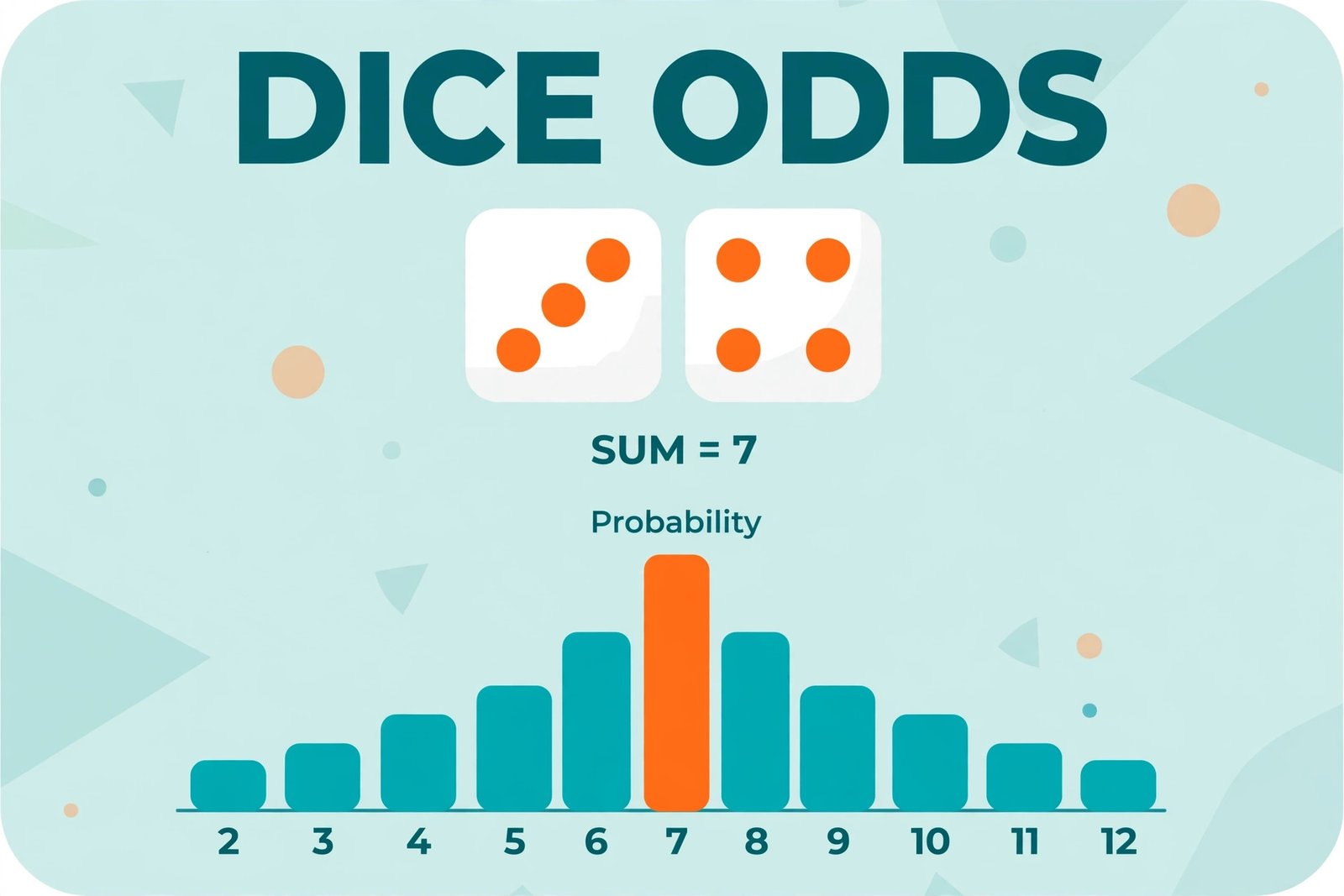
Dice Probabilities Made Simple
Learn dice probabilities the easy way: one die, two dice, why 7 is most common, and how to use the odds in board games…
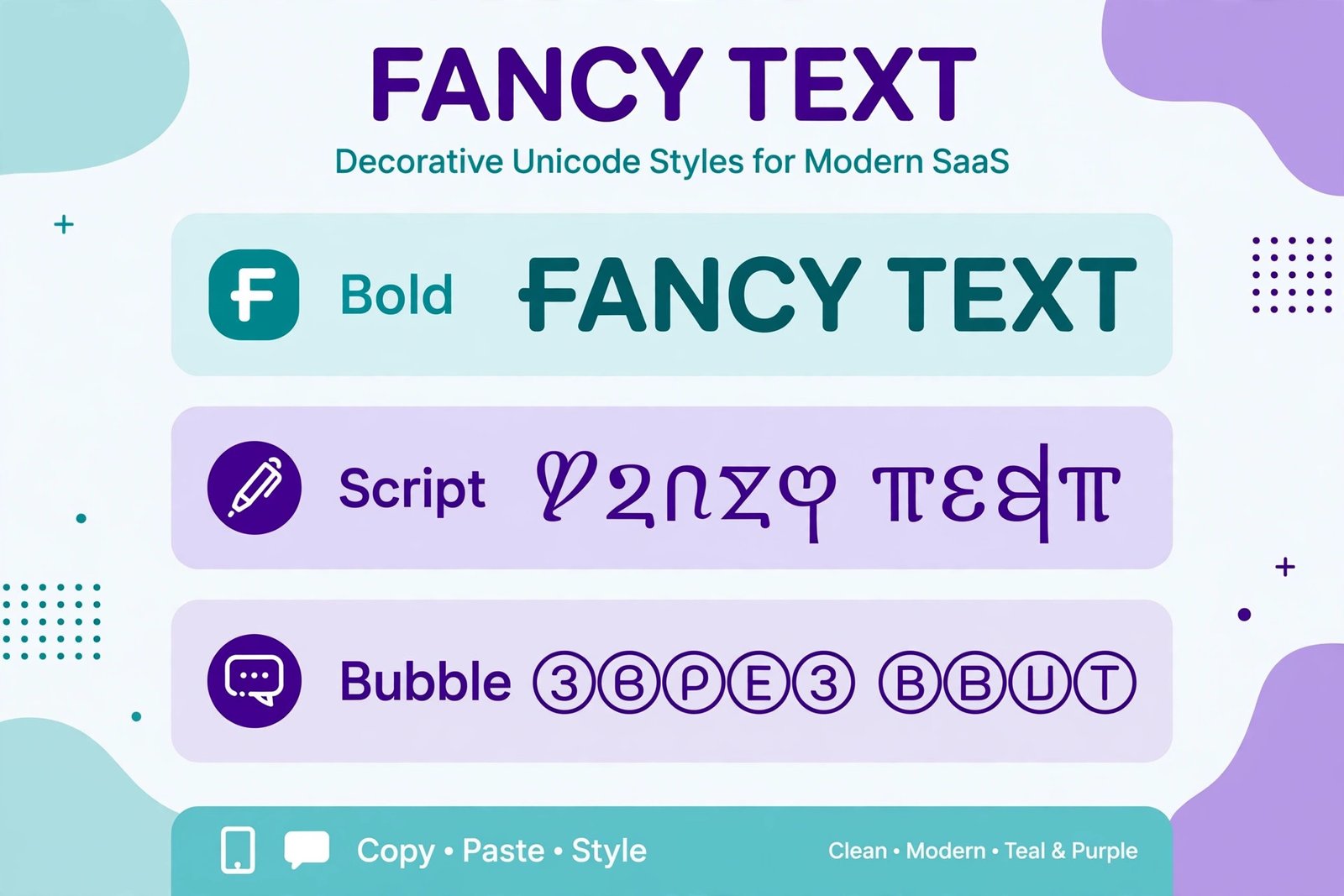
How to Make Fancy Text for Bios and Posts
Learn how to make fancy text for Instagram bios, WhatsApp, Discord and TikTok using Unicode styles — plus where fancy…

How to Improve Your Typing Speed (WPM)
Learn how to improve your typing speed with home-row technique, accuracy drills, and a 2-week practice plan. Real WPM…