How to Read Roman Numerals: A Complete Guide with Worked Examples
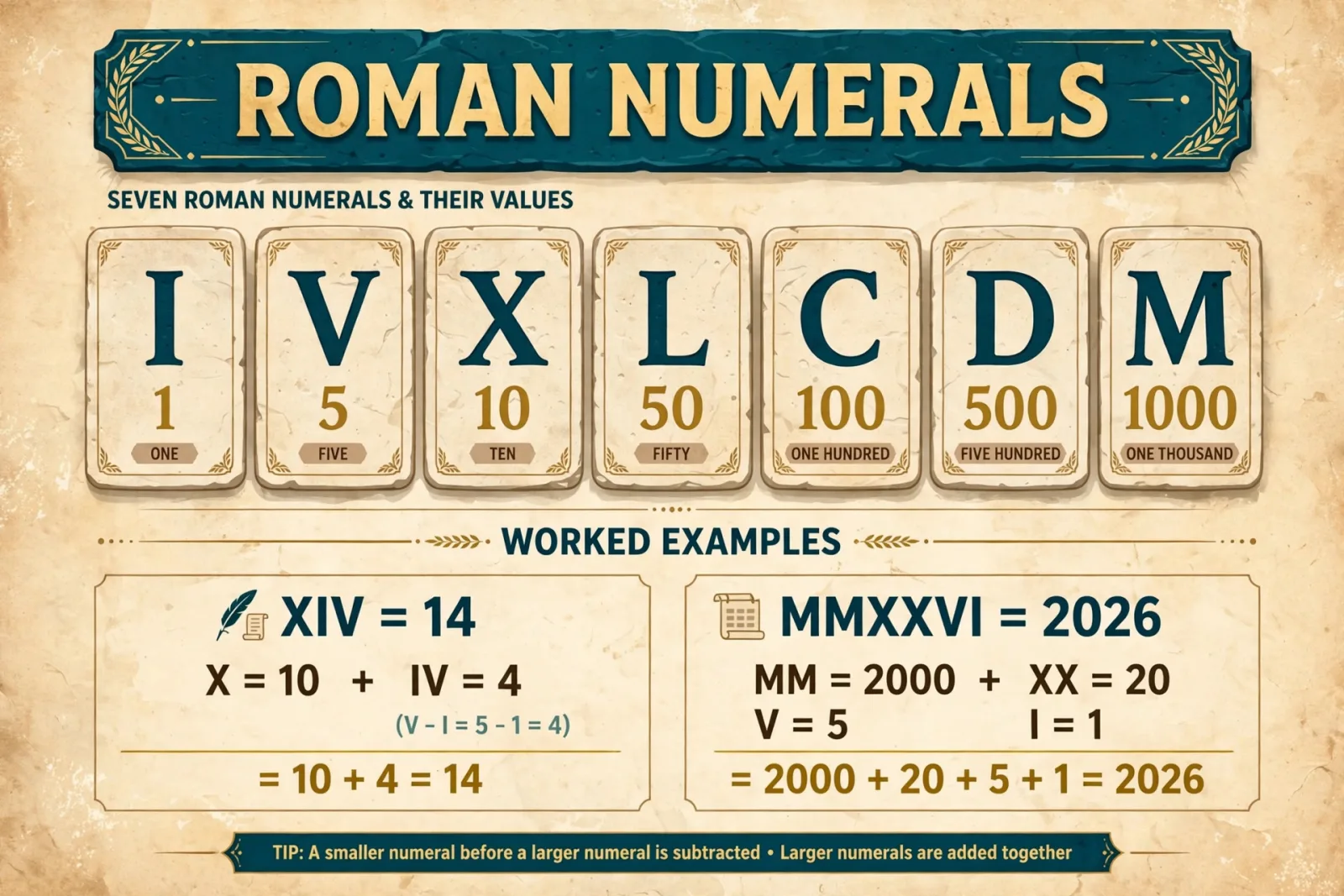
Roman numerals use just seven symbols: I = 1, V = 5, X = 10, L = 50, C = 100, D = 500, M = 1,000. Normally you read left to right and add each value (VI = 5 + 1 = 6). When a smaller symbol stands directly before a larger one, subtract it instead: IV = 4 (5 − 1), IX = 9 (10 − 1), XL = 40, XC = 90, CD = 400, CM = 900. So XIV = 10 + (5 − 1) = 14, and MCMXCIV = 1,000 + (1,000 − 100) + (100 − 10) + (5 − 1) = 1,994.
On this page
Roman numerals look mysterious, but the whole system runs on only seven letters and three simple rules. Once you know them, you can read a clock face, decode a Super Bowl number, or figure out the year carved into a building's cornerstone without hesitation.
If you want an instant answer instead, the Roman numeral converter translates between Roman and modern numbers in both directions — but learning to read them yourself takes about ten minutes and is surprisingly satisfying.
The Seven Symbols
Every Roman numeral is built from these seven letters. Memorize them and you already know 90 percent of the system:
| Symbol | Value | Memory hint |
|---|---|---|
| I | 1 | one stroke, like a tally mark |
| V | 5 | looks like an open hand |
| X | 10 | two V's joined |
| L | 50 | from Latin quinquaginta (50) |
| C | 100 | from Latin centum (100) |
| D | 500 | half of M visually |
| M | 1,000 | from Latin mille (1,000) |
These are the only building blocks. There is no symbol for zero, and every larger number is made by combining them according to the rules below.
Rule 1: Read Left to Right and Add
When the symbols go from larger to smaller (or stay equal), you simply add their values:
- II = 1 + 1 = 2
- VI = 5 + 1 = 6
- VII = 5 + 1 + 1 = 7
- XV = 10 + 5 = 15
- LXX = 50 + 10 + 10 = 70
- MM = 1,000 + 1,000 = 2,000
This "addition rule" handles most of what you meet in daily life: chapter numbers, Super Bowl editions, and the hours on many clocks.
Rule 2: The Subtraction Rule
When a smaller symbol appears directly before a larger one, subtract the smaller from the larger. Only six such pairs exist:
- IV = 5 − 1 = 4
- IX = 10 − 1 = 9
- XL = 50 − 10 = 40
- XC = 100 − 10 = 90
- CD = 500 − 100 = 400
- CM = 1,000 − 100 = 900
The subtraction rule has strict limits, which is where most learners make mistakes:
- Only I, X, and C can ever be placed before a larger numeral. You will never see V, L, or D used for subtraction.
- I may only precede V and X (IV = 4, IX = 9).
- X may only precede L and C (XL = 40, XC = 90).
- C may only precede D and M (CD = 400, CM = 900).
- Only one smaller symbol may be subtracted at a time. IIX is not a valid way to write 8 — the correct form is VIII.
Rule 3: The Repetition Rule
A symbol may repeat, but no more than three times in a row:
- III = 3 (correct)
- IIII = 4 (wrong — the correct form is IV)
- XXX = 30 (correct)
- CCCC = 400 (wrong — the correct form is CD)
There is one exception to be aware of: clock faces. Clocks traditionally use IIII for four o'clock instead of IV — a centuries-old horological convention, not a mistake. But in writing and in tests, IV is correct.
V, L, and D are never repeated. You will never see VV for 10 (that is X) or LL for 100 (that is C).
How to Read Any Roman Numeral: The Step-by-Step Method
With the three rules in place, here is a reliable procedure that works on every valid Roman numeral:
- Start from the left. Look at the first symbol.
- Compare it with the next symbol. If it is smaller, it forms a subtraction pair with the next symbol: subtract and treat the pair as one block, then move on past it.
- If it is equal or larger, add its value and move one step right.
- Add up all the blocks.
Let's apply this to XIV:
- First symbol X (10), next symbol I (1). X is larger, so add 10.
- Now look at I (1) followed by V (5). I is smaller, so subtract: 5 − 1 = 4.
- Total: 10 + 4 = 14.
And to MCMXCIV (the year 1994):
- M (1,000), next symbol C (100). M is larger → add 1,000.
- C (100) followed by M (1,000). C is smaller → subtract: 1,000 − 100 = 900.
- X (10) followed by C (100). X is smaller → subtract: 100 − 10 = 90.
- I (1) followed by V (5). I is smaller → subtract: 5 − 1 = 4.
- Total: 1,000 + 900 + 90 + 4 = 1,994.
Worked Examples
XIV = 14. X (10) is larger than I, so add 10; then IV = 4. Total 14.
XLIV = 44. XL = 50 − 10 = 40; then IV = 4. Total 44.
XCIX = 99. XC = 100 − 10 = 90; then IX = 10 − 1 = 9. Total 99.
CDXLIV = 444. CD = 500 − 100 = 400; XL = 40; IV = 4. Total 444.
MCMXCIV = 1,994. M = 1,000; CM = 900; XC = 90; IV = 4. Total 1,994.
MMXXVI = 2,026. M + M = 2,000; X + X = 20; V + I = 6. Total 2,026 — the current year.
Writing Numbers in Roman Numerals
Reading teaches writing: work through the number from largest to smallest, peeling off one subtraction pair or symbol at a time:
- 2026 → MMXXVI. Take 1,000 twice (MM = 2,000), then 10 twice (XX = 20), then V + I (6). MMXXVI.
- 99 → XCIX. Take the 90 pair (XC), then the 9 pair (IX). Never write IC — I may only precede V and X.
- 400 → CD. One subtraction pair: 500 − 100.
- 900 → CM. One subtraction pair: 1,000 − 100.
A handy trick: split the number into thousands, hundreds, tens, and ones, convert each part separately, and join them. For 2026: 2000 = MM, 0 hundreds, 20 = XX, 6 = VI → MMXXVI.
Numbers Larger Than 3,999: The Vinculum
Romans wrote numbers above 3,999 with a horizontal bar over a symbol — the vinculum — which multiplies the value by 1,000. A V with a bar above it means 5,000; an X with a bar means 10,000; an M with a bar means 1,000,000. Modern keyboards cannot type these easily, so in plain text you may see them written with parentheses, like (V) for 5,000. For everyday purposes — clock faces, book chapters, Super Bowls — you will never need the vinculum.
Common Mistakes to Avoid
- Writing IIII instead of IV. Remember, four repeats are forbidden (except on traditional clock faces).
- Writing IC for 99. I can only be subtracted from V and X, so 99 must be XCIX. IC is invalid.
- Writing IL for 49. I can never be subtracted from L, so 49 is XLIX.
- Repeating V, L, or D. VV, LL, and DD are never valid — use X, C, and M.
- Adding when you should subtract. In XC, the X comes before the larger C, so it is 90 — not 110.
Where You Will See Roman Numerals
Roman numerals survive in surprisingly many places:
- Clock faces. Traditional clocks use I–XII for the hours (often with IIII for four).
- Super Bowl editions. The championship game uses Roman numerals: Super Bowl LVIII was the 58th edition.
- Popes and monarchs. Pope John Paul II, Queen Elizabeth II, King Charles III — the numeral marks the order of rulers with the same name.
- Book chapters and outlines. Many books number chapters I, II, III, IV.
- Movie sequels. Rocky II, The Godfather Part II, and similar titles use them for style.
- Building cornerstones and monuments. Cornerstones often carry the construction year in Roman numerals, like MCMXXVI (1926).
Quick Practice
Decode these, then check your answers below:
- XXIV
- LXXVII
- DCCXLV
- MMMCMXCIX
Answers: 1) XX (20) + IV (4) = 24. 2) L (50) + XX (20) + VII (7) = 77. 3) D (500) + CC (200) + XL (40) + V (5) = 745. 4) MMM (3,000) + CM (900) + XC (90) + IX (9) = 3,999.
Frequently asked questions
What is the fastest way to read Roman numerals?
Memorize the seven symbols (I=1, V=5, X=10, L=50, C=100, D=500, M=1,000), then scan left to right: add when a symbol is equal to or larger than the next one, and subtract when a smaller symbol stands before a larger one. In practice, spotting the six subtraction pairs — IV, IX, XL, XC, CD, CM — is the whole trick, since everything else is simple addition.
What does IV mean in Roman numerals?
IV means 4. The I (1) stands before the larger V (5), so you subtract: 5 − 1 = 4. This is the subtraction rule. Note the exception on traditional clock faces, which often display IIII for four o'clock by long-standing horological convention, even though IV is the correct written form.
How do you read MCMXCIV?
MCMXCIV = 1,994. Break it into blocks from left to right: M = 1,000; CM = 1,000 − 100 = 900; XC = 100 − 10 = 90; IV = 5 − 1 = 4. Adding the blocks: 1,000 + 900 + 90 + 4 = 1,994.
Why is 99 written XCIX and not IC?
Because of the subtraction rule's limits: I may only be placed before V and X, never before C. So 99 must be written as XC (90) followed by IX (9), giving XCIX. IC is not a valid Roman numeral — a frequent mistake.
What Roman numeral is 2026?
2026 is MMXXVI. Break it into parts: 2,000 = MM, 20 = XX, 6 = VI. Joined together: MMXXVI. You can check any conversion with the Roman numeral converter (https://toolfacil.com/roman-numeral-converter/).
Which Roman numerals can never be repeated?
V, L, and D can never be repeated — VV, LL, and DD are invalid (use X, C, and M instead). I, X, C, and M may repeat, but at most three times in a row (III, XXX, CCC, MMM). Four repeats are forbidden: write IV instead of IIII, and CD instead of CCCC.
Related guides

Dice Probabilities Made Simple
Learn dice probabilities the easy way: one die, two dice, why 7 is most common, and how to use the odds in board games…

How to Make Fancy Text for Bios and Posts
Learn how to make fancy text for Instagram bios, WhatsApp, Discord and TikTok using Unicode styles — plus where fancy…

How to Improve Your Typing Speed (WPM)
Learn how to improve your typing speed with home-row technique, accuracy drills, and a 2-week practice plan. Real WPM…

How to Generate Random Numbers Fairly
Learn how to generate random numbers fairly: the range formula, worked examples, no-repeat draws, and the mistakes that…