How to Use Random Letters for Word Games
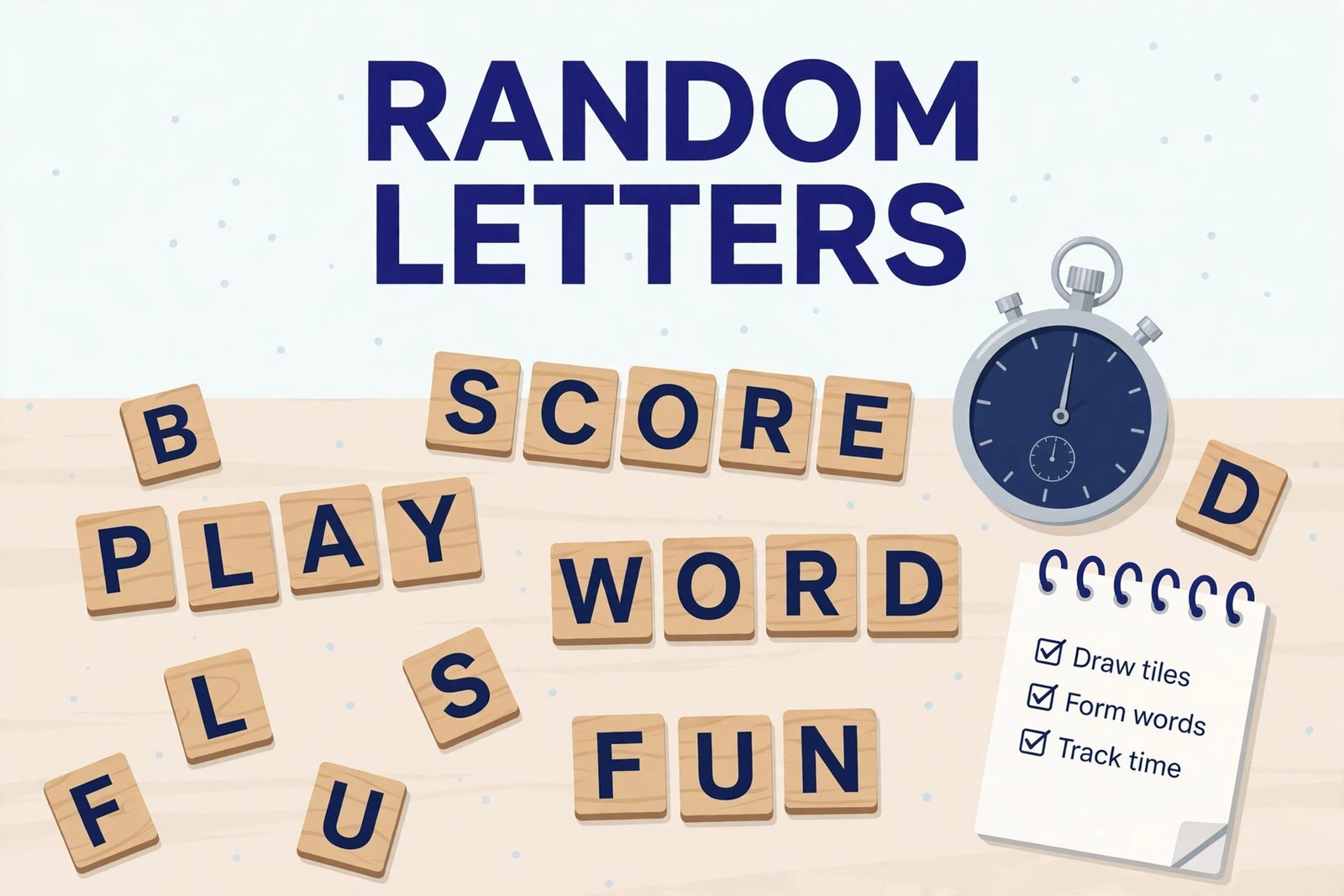
Pick one random letter, set a timer of 60 to 180 seconds, and have every player write one answer per category that starts with that letter. Score one point for each valid, unique answer and zero for duplicates or blank categories. A random letter generator keeps the draw fair, because no player chooses a letter that suits them.
On this page
What a random letter round actually is
A random letter round is the simplest possible word game: one letter, chosen by chance, becomes the starting point for everything that follows. The letter is the constraint, and the constraint is what makes the game interesting. Without it, players would always pick easy words. With it, a letter like S produces a flood of answers, while a letter like Q forces players to dig into the corners of their vocabulary.
You do not need special equipment. You need a way to draw a letter fairly, a list of categories or a game format, a timer, and a way to keep score. ToolFacil's Random Letter Generator does the drawing for you: one tap, one letter, no arguments about whether someone peeked or picked a favourite. The rest of this guide is the method the tool page does not cover — how to run the round, how to score it, and how to adjust it for children, classrooms, and competitive adults.
One design principle runs through everything below: the letter must be random and visible to everyone at the same time. If one player draws in secret and announces the letter, the others will suspect, fairly or not, that the draw was rigged. Draw on a shared screen, read the letter aloud, and start the timer immediately.
The classic Scattergories-style round, step by step
This is the format most people mean when they say "letter game." It works for 2 to 8 players, takes about 5 minutes per round, and needs no board.
- Agree on the categories before you draw. Ten categories is a good default for adults; five is better for children or a first game. Classic categories include: animal, country, food or drink, job, household object, sport, film or book, and "something you wear." Write the list where everyone can see it, and fix any ambiguity now — for example, decide whether a food brand counts as a food, and whether a country must be a sovereign state.
- Draw the letter. Use the generator, and exclude nothing on the first round. Announce the letter and start the timer in the same breath.
- Set the timer. 90 seconds is the sweet spot for 10 categories with adults; 120 seconds suits children or a relaxed game. Three minutes is generous and works well for a classroom. Shorter timers reward quick recall; longer timers reward unusual answers.
- Write in silence. Each player writes one answer per category, starting with the drawn letter. No talking, no hints, no looking at another player's sheet. Spelling does not have to be perfect at this stage, but the answer must be legible enough to judge.
- Stop when the timer ends. Pens down means pens down. An answer finished after the buzzer does not count, and enforcing this once, kindly, prevents arguments in every later round.
- Read out and judge. Go category by category. Each player reads their answer aloud. The group judges whether it is valid. Then apply the scoring rule in the next section.
- Repeat with a new letter. Five rounds make a satisfying game of about 25 to 30 minutes. Keep a running total rather than declaring a winner after one round, because a single lucky letter can distort a whole evening.
A useful house rule: an answer counts if a reasonable person would accept it. "Spain" is a country. "Sandwich" is a food. "Singer" is a job. Edge cases — "Scotland" as a country, "Salsa" as both a food and a dance — should be decided by majority vote before scoring, not argued after the points are counted.
A full round worked out: the letter S
Theory is easy; scoring disputes are where games actually break down. Here is a complete three-player round, letter S, five categories, so you can see exactly how the judging works. The categories are: animal, country, food, job, object. The timer is 90 seconds.
| Player | Animal | Country | Food | Job | Object |
|---|---|---|---|---|---|
| Ana | Snake | Spain | Sandwich | Singer | Scissors |
| Ben | Shark | Spain | Soup | Sailor | Sofa |
| Cara | Snail | Sweden | Salad | Surgeon | Spoon |
Now judge category by category. In the animal column, all three answers are different and valid, so each player scores 1. In the country column, Ana and Ben both wrote Spain, so both score 0 for that category under the standard unique-answer rule, while Cara's Sweden is unique and scores 1. In the remaining columns, every answer is unique and valid, so each player scores 1 per column. The totals are therefore: Ana 4 points (animal, food, job, object; 0 for the duplicated country), Ben 4 points (the same pattern), and Cara 5 points (all five unique). Cara wins the round not because she knew more words, but because she avoided the obvious answer. That is the heart of the game: the obvious answer is the dangerous answer. Experienced players deliberately skip the first word that comes to mind — Spain, snake, sandwich — and hunt for the second or third one, because uniqueness is worth as much as correctness.
Two variations change this dynamic completely. In the "all valid answers count" variant, duplicates still score 1, and the game becomes a pure vocabulary race; use it for young children, for whom a zero for a correct answer feels unfair. In the "bonus for alliteration" variant, an answer that also matches a second condition — for example, a two-word answer where both words start with the letter, like "Sea snake" — earns 2 points instead of 1. Agree on the variant before the first round, and do not switch mid-game.
Five more games that use random letters
The Scattergories format is only the start. The same single draw powers at least five other games, and rotating between them keeps a game night fresh without buying anything new.
Word chains
Draw a letter, then build a chain where each word starts with the last letter of the previous word. Starting from the drawn letter C: Cat, then Tiger (starts with T, the last letter of Cat), then Rabbit, then Turtle, then Elephant. Each link is checked as you go: Cat ends in T, Tiger starts with T and ends in R, Rabbit starts with R and ends in T, Turtle starts with T and ends in E, Elephant starts with E. The chain breaks when a player cannot continue within 10 seconds, repeats a word, or plays a word that does not follow the last-letter rule. For children, allow proper nouns and drop the timer; for adults, ban proper nouns and require words of at least four letters, which makes the chain much harder to sustain past ten links.
Anagrams
Draw five or six letters and race to build the longest real word from them, using each letter at most once. With the letters A, E, L, P, P, the possible words include Apple (all five letters), Leap, Pale, Peal, and Plea (four letters each). Score 1 point per letter of your longest valid word, so Apple scores 5 and Leap scores 4. A good classroom version uses the letters of a spelling-list word, scrambled: pupils unscramble them against the clock, which turns a spelling test into a puzzle. If no player finds a word using all the letters, the longest word wins the round.
Acrostics
Draw a letter, then write a short poem or sentence where each line starts with successive letters, or spell a word vertically with one line per letter. The simplest version: draw the word SPRING as your theme and write six lines starting with S, P, R, I, N, G. Judge on completion first and wit second, and keep it untimed or generously timed, because acrostics reward creativity rather than speed. This is the best format for mixed-age groups, since a funny line from a child can beat a polished line from an adult.
Boggle-style grids
Draw sixteen letters and arrange them in a 4 by 4 grid, then find words by joining adjacent letters — horizontally, vertically, or diagonally — without reusing a square in the same word. Sample grid rows:
| S | T | A | R |
| E | L | P | O |
| N | I | M | E |
| D | A | C | K |
From this grid you can trace STAR across the top row, TALE (T, A, L, E, moving from the top row down to the second row), and MICE (M, I, C, E, traced through the lower rows). Score the usual way: 3-letter words score 1 point, 4-letter words score 1 point, 5-letter words score 2 points, 6-letter words score 3 points, and 7 or more letters score 5 points. Building a fair grid by hand is fiddly, which is exactly why a generator helps: draw sixteen letters, place them in rows, and play. If the grid produces almost no words, redraw — a grid with no vowels is a broken game, not a hard one.
Classroom spelling drills
Random letters turn rote spelling practice into a game pupils actually want to play. The teacher draws a letter and a target: "Find five words starting with B that you can spell correctly." Pupils write their words, then spell one aloud; a correctly spelled word scores a point, and a misspelled word scores nothing but goes on the board for the class to correct together. Rotate the target each round: words with a double letter, words with a silent letter, words of at least seven letters, or words from this week's spelling list. The randomness matters here too — pupils cannot pre-memorise answers for a letter they have not seen yet, so the drill tests real spelling rather than recall of a prepared list.
Why some letters are harder: letter frequency
Not all letters are equal, and players feel it instantly. Rounds with S, C, or T overflow with answers. Rounds with Q, Z, or X stall. The reason is letter frequency: in ordinary English text, some letters appear far more often than others, so our mental word lists are much deeper for common letters. The most frequent English letters are E, at roughly 12.7 percent of all letters in typical text, followed by T at about 9.1 percent, A at about 8.2 percent, O at about 7.5 percent, I at about 7.0 percent, and N at about 6.7 percent. At the other end, J and X each account for only about 0.15 percent, Q for about 0.10 percent, and Z for about 0.07 percent. In practical terms, E appears roughly 180 times as often as Z. That is why a Z round feels like a different game: there simply are fewer Z words to reach for, and most players' Z vocabulary is limited to zebra, zoo, and zip.
This has two consequences for game design. First, if you draw letters uniformly — each of the 26 letters equally likely — then the chance of drawing Q, Z, or X on any single draw is 3 out of 26, or about 11.5 percent. Roughly one round in nine will be a hard-letter round, which is frequent enough to be exciting but not so frequent that the game stalls. Second, if you want a gentler game, you should not draw uniformly at all: use the difficulty settings below instead, and say so openly. A rigged draw that players discover feels worse than a hard letter they accepted in advance.
Difficulty settings that actually work
Use these settings openly, agreed before play, rather than quietly skipping letters you dislike.
| Setting | Letter pool | Best for |
|---|---|---|
| Beginner | Vowels and common consonants only (A, E, I, O, U, B, C, D, F, G, H, L, M, N, P, R, S, T) | Children under 10, first-time players |
| Standard | All 26 letters, uniform draw | Family games, classrooms |
| Expert | All 26 letters, but a Q, Z, X, J, or K round scores double | Competitive adults |
| Vowels only | A, E, I, O, U | Quick warm-ups, young spellers |
| Consonants only | The 21 consonants | Vocabulary stretch for strong players |
| Exclude rare letters | All letters except Q, X, Z | Relaxed games where nobody wants a stalled round |
Two more dials matter as much as the letter pool. The timer dial: 60 seconds for experts, 90 seconds standard, 180 seconds for classrooms. The category dial: concrete categories (animal, food, country) are easier than abstract ones (something that makes you happy, a reason to be late), which reward lateral thinking but cause more judging disputes. Turn only one dial at a time when you change difficulty, so players can tell what made the round harder.
Fair-play rules worth writing down
Most letter-game arguments are preventable, and the prevention costs one minute before the first round.
- One timer, visible to all: Use a phone timer on the table or a shared screen, not a silent mental count. When it rings, pens go down immediately; there is no "just finishing this word."
- Judge before scoring, in the open: Read answers category by category, not player by player. This stops a strong personality from dominating the judging, because each answer is judged on its own before anyone's total is known.
- Duplicates score zero in the standard game: This is the single rule new players most often dispute, so state it before round one, with an example: two players writing Spain both score zero. If your group dislikes it, use the all-valid-answers variant instead — but pick one and stick to it for the whole game.
- A disputed answer is decided by majority vote, then the game moves on: Allow one 30-second discussion per dispute. If the group cannot agree, the answer scores zero and play continues. Parking a dispute for "later" guarantees it will be argued about all evening.
- No phones, no dictionaries during a timed round: Looking up words defeats the purpose of a recall game. Dictionaries are welcome between rounds, when a disputed word can be checked properly — and the player who challenged it buys the next round of snacks, in friendly games at least.
- The letter draw is final: No redrawing because the letter is hard. The one exception: if you agreed a difficulty setting in advance and the draw breaks it — for example, a consonant appears in a vowels-only game because of a settings mistake — redraw openly and say why. A redraw with a stated reason preserves trust; a silent redraw destroys it.
Classroom and family variations
For a classroom of 25 to 30 pupils, run the game in teams of four or five rather than individually. Each team submits one answer per category, which cuts judging time from half an hour to about five minutes and lets weaker spellers contribute ideas while stronger spellers check spelling. Award a team point for each unique valid answer, and put the best disputed answers on the board as a vocabulary lesson in their own right.
For families with mixed ages, handicap the game rather than dumbing it down: adults play with two fewer categories, or adults must give two-word answers, or children get a 30-second head start. Children notice when adults are obviously holding back, and they resent it less than they resent losing every round by ten points.
For remote play, one player shares their screen with the generator, draws the letter live, and starts a shared timer. Answers go in a private message to the host, who reads them out for judging. The private-message step matters: without it, the fastest typist's answers appear in the chat and everyone else copies the categories they missed.
Using the generator well
A generator is only as fair as the routine around it. Draw once per round, show the result to everyone, and do not draw again until the round is scored. If you are playing several games in one evening, keep a visible list of letters already used, and avoid repeating a letter until all 26 have appeared at least once — a simple way to stop the same easy letter dominating the night. And when a round ends in a dispute about whether a word exists, check it in a dictionary between rounds, not during them. The game is supposed to be fast, argumentative in a friendly way, and over in half an hour. The letter is the spark; the rules are what keep it fair.
Frequently asked questions
How many players work best for a random letter game?
Three to six players is ideal. With two players, duplicates are rare and the scoring loses its tension; with more than eight, judging takes longer than playing. For larger groups, split into teams of four or five and play team against team.
How long should the timer be?
Ninety seconds for ten categories is the standard adult setting, and 120 seconds suits children or beginners. Sixty seconds makes a fast, tense expert game, while 180 seconds works for classrooms or players writing in a second language. Whatever you choose, use the same timer for every round in a game.
What happens if two players write the same answer?
In the standard Scattergories-style rule, both score zero for that category, because the answer was not unique. In the gentler all-valid-answers variant, both score one point. Choose the rule before the first round and apply it consistently.
Can I exclude Q, Z, and X from the draw?
Yes, and for a relaxed family game you probably should. Use the "exclude rare letters" setting: draw from the other 23 letters. For competitive play, keep them in — a hard-letter round is worth about 11.5 percent of draws under a uniform draw, and handling it well is a genuine skill.
How do I make the game fair for children playing with adults?
Give children a longer timer, fewer categories, or a head start, and let adults play a harder variant, such as two-word answers or abstract categories. Handicaps stated openly feel fair; adults secretly holding back feels patronising and children notice.
What makes a good category list?
Mix concrete and slightly tricky categories: animal, country, food, job, and object are safe; add one wild category per game, such as "something found in a kitchen" or "a reason to be late," to force creative answers. Avoid categories so broad that anything counts, like "thing," and categories so narrow that only experts can answer.
Can random letters help with spelling practice?
Yes. Drawing an unseen letter stops pupils from pre-memorising answers, so the drill tests real spelling. Rotate targets — double letters, silent letters, words of at least seven letters — and correct misspelled words together on the board rather than simply marking them wrong.
Related guides
How to Split Fair Teams in Seconds
Learn how to split fair teams fast: random draws, even and uneven groups, no-repeat rounds, and when to use a seeded…
Dice Probabilities Made Simple
Learn dice probabilities the easy way: one die, two dice, why 7 is most common, and how to use the odds in board games…
How to Make Fancy Text for Bios and Posts
Learn how to make fancy text for Instagram bios, WhatsApp, Discord and TikTok using Unicode styles — plus where fancy…

How to Improve Your Typing Speed (WPM)
Learn how to improve your typing speed with home-row technique, accuracy drills, and a 2-week practice plan. Real WPM…