What Day Is It Today? How to Find the Date and Day of the Week
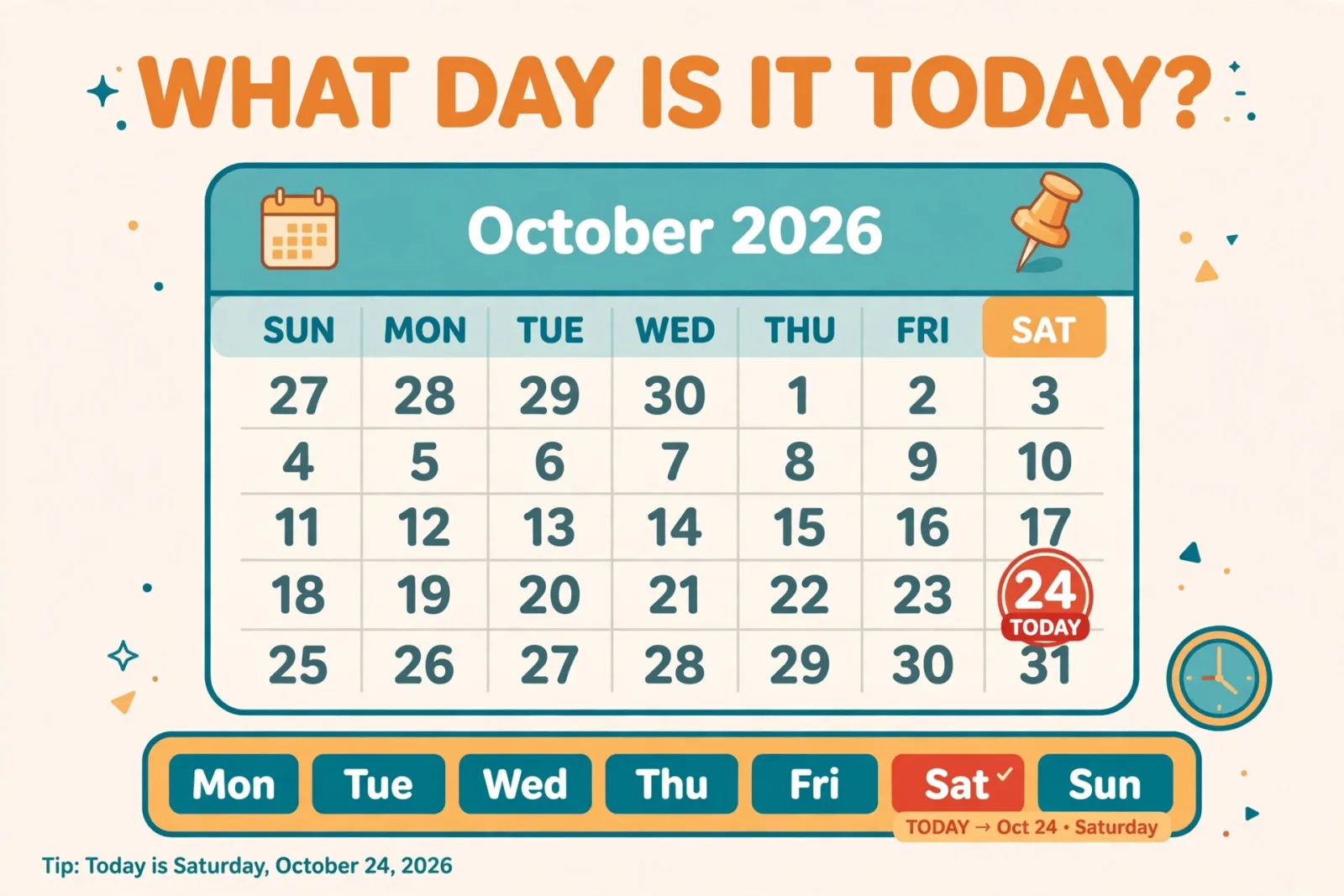
Today is Saturday, October 24, 2026 (as of this article's publication — the answer changes daily). For the live answer any time, the free today's date tool (https://toolfacil.com/todays-date/) shows the current date, the day of the week, the ISO week number, and the day of the year in one click.
On this page
Asking "what day is it today?" is one of the most common questions in the world — people ask it hundreds of millions of times every month. Sometimes the answer comes in a glance at a phone screen; sometimes it hides behind confusion over date formats, calendars that start on different days, or the eternal question of whether 05/06 means May 6 or June 5. This guide gives you the answer for right now, then teaches you the skill behind it: how to find any date, read it in any format, and even compute the day of the week by hand.
If you only need today's date at this very moment, the today's date tool shows it live — the full date, the weekday, the week number, and the day of the year. The rest of this guide makes sure you never have to wonder about dates again.
The Fastest Ways to Find Today's Date
Before reaching for the internet, check what is already in front of you:
- Your phone's lock screen. On both iPhone and Android, the lock screen shows the full date and day of the week without unlocking anything. Pull down the notification shade on Android, and the date appears in the top-left corner.
- Your computer's taskbar. On Windows, the bottom-right corner shows the date (click it to open the calendar). On macOS, the menu bar at the top right shows the date — click it for a full calendar.
- Your smart speaker. "Hey Google, what's the date today?" and "Alexa, what day is it?" both answer instantly, hands-free.
- The search box. Typing "what day is it" into Google shows the current date directly above the results, with no site visit needed.
- The free tool. ToolFacil's today's date page shows the current date, weekday, ISO week number, and day of the year, and it works on any device.
Any of these works, but they only answer for right now. To check a date in the past or future — when was Easter, what day is your birthday next year, which day of the week did you start school — you need to read dates confidently and know how calendars compute weekdays.
Reading and Writing a Full Date Correctly
Dates look different around the world, and that is where most confusion starts.
Long vs. short forms. The long form writes everything out: "Saturday, October 24, 2026." The short form compresses it: "10/24/2026" or "Oct 24, 2026." Long forms are unambiguous; short forms are where mistakes happen.
The great month-first vs. day-first divide. In the United States, the convention is month/day/year — so 10/24/2026 means October 24. In most of the rest of the world (the UK, Europe, Latin America, Asia), it is day/month/year — so 24/10/2026 is October 24. The string "05/06/2026" therefore means May 6 in New York and June 5 in Madrid. Whenever ambiguity matters — flights, contracts, medical forms — write the month as a word.
ISO 8601: the format that cannot be misunderstood. The international standard writes dates as YYYY-MM-DD — year first, then month, then day, with zero padding. Today is 2026-10-24 in ISO 8601. Because it goes from largest unit to smallest, it sorts correctly as plain text and means the same thing in every country. Developers, scientists, and data teams use it for exactly that reason, and it is the safest format for anything official or cross-border.
How to say the date out loud. In American English: "Saturday, October twenty-fourth, twenty twenty-six." In British English: "Saturday the twenty-fourth of October, twenty twenty-six." In writing, the ordinal ("24th") is common in the UK and informal in the US. Either way, the full written form always starts with the day of the week, then the month and day, then the year.
How to Compute the Day of the Week by Hand
Believe it or not, you can find the weekday of any date with pencil and paper. Here are two real methods — the easy mental one and the formulaic one.
The Doomsday rule
The Doomsday rule, invented by mathematician John Horton Conway, works on one insight: certain dates always fall on the same weekday in a given year, called that year's Doomsday. Find the year's Doomsday, then count from the nearest one.
First, find 2026's Doomsday. The Doomsday is always the last day of February — February 28 in a common year, February 29 in a leap year (2026 is not a leap year). February 28, 2026 is a Saturday, so 2026's Doomsday is Saturday.
Now memorize the Doomsdays — they are chosen to be easy:
- 4/4, 6/6, 8/8, 10/10, 12/12 — the even-month pairs
- 9/5 and 5/9, 7/11 and 11/7 — the "I work from 9 to 5 at the 7-Eleven" pairs
- The last day of February, and January 3 (January 4 in leap years)
Every one of these fell on Saturday in 2026. So: what day is October 24, 2026? The October Doomsday is 10/10 — Saturday. October 24 is exactly 14 days later, and 14 is a multiple of 7, so October 24 is also a Saturday. What about Christmas Day, December 25? The December Doomsday is 12/12 — Saturday. December 25 is 13 days later; 13 ÷ 7 leaves a remainder of 6, so we move six days forward from Saturday: Sunday, Monday, Tuesday, Wednesday, Thursday, Friday. Christmas 2026 falls on a Friday.
Zeller's congruence
The Zeller's congruence formula computes the weekday of any Gregorian date directly. Here it is, step by step:
h = (q + floor(13(m+1)/5) + K + floor(K/4) + floor(J/4) + 5J) mod 7
where q is the day of the month, m is the month (January and February count as months 13 and 14 of the previous year), K is the year of the century, and J is the century. The result maps to: 0 = Saturday, 1 = Sunday, 2 = Monday, 3 = Tuesday, 4 = Wednesday, 5 = Thursday, 6 = Friday.
Worked example: what day was July 4, 2026? Here q = 4, m = 7, K = 26, J = 20.
- floor(13 × 8 / 5) = floor(104/5) = 20
- floor(26/4) = 6
- floor(20/4) = 5
- Sum: 4 + 20 + 26 + 6 + 5 + 100 = 161
- 161 ÷ 7 = 23 with remainder 0 — h = 0, which is Saturday
And indeed, July 4, 2026 fell on a Saturday. One more, with the January rule: January 1, 2027 becomes q = 1, m = 13, K = 26, J = 20. The sum is 1 + 36 + 26 + 6 + 5 + 100 = 174; 174 mod 7 = 6, which is Friday — January 1, 2027 is a Friday. Both results match the actual calendar.
These methods are how calendar software double-checks itself, and they are the same arithmetic running inside the today's date tool every time it loads.
What Week of the Year Is It? ISO Week Numbers Explained
Dates have a bigger cousin: the week number. The ISO 8601 standard defines week 1 as the week containing the year's first Thursday, and weeks run Monday through Sunday. Today — Saturday, October 24, 2026 — falls in ISO week 43 of 2026.
Week numbers matter more than most people realize: project schedules, payroll periods, manufacturing planning, and European business correspondence all use them ("let's ship in week 46"). There are 52 or 53 ISO weeks in a year; 2026 has 53. Note that the first few days of January can belong to week 52 of the previous year, and the last days of December can belong to week 1 of the next — January 1, 2027, for instance, is in ISO week 53 of 2026.
The related number is the day of the year: October 24 is the 297th day of 2026, with 68 days remaining (2026 has 365 days). Christmas Day is day 359. Countdowns, "days until" calculators, and progress bars for the year all run on this simple counting.
Why the Date Can Differ Depending on Where You Are
At any given moment, two different calendar dates are in use on Earth — because of the International Date Line. When it is Saturday evening in New York, it is already Sunday morning in Tokyo. The line runs through the Pacific Ocean: cross it eastbound and you repeat a day; cross it westbound and you skip one.
This is why "what day is it?" genuinely has two correct answers right now, depending on where you stand. Time zones handle the hours (UTC−5 vs UTC+9), but only the date line flips the calendar day. It is also why your phone can show a different date than your laptop: devices disagree when one has the wrong time zone set. If your gadget shows the wrong day, check its time zone setting before doubting the calendar.
Five Date Mistakes That Cause Real Problems
- Writing 05/06/2026 on international paperwork. May 6 or June 5? Nobody can tell. Write "6 May 2026" or use ISO 2026-05-06.
- Assuming every calendar starts on Sunday. Wall calendars in the US start weeks on Sunday; most of Europe and all of ISO 8601 start on Monday. A "week 43" plan shifts by a day if you read the wrong layout.
- Forgetting time zones in online meetings. "October 24" in San Francisco is already "October 25" in Sydney for part of the day. Put the time zone on every invite.
- Hard-coding "today" in spreadsheets and code. A cell that says "today" goes stale tomorrow. Use the =TODAY() function or a live date, not typed text.
- Trusting the date on an old printout. Calendars expire; the device that generated them does not. For anything important, confirm against a current source — like the live date tool.
Frequently asked questions
What day is it today?
Today is Saturday, October 24, 2026 — as of this article's publication. Because the answer changes every 24 hours, the live answer is always available on the free today's date tool (https://toolfacil.com/todays-date/), which also shows the week number and day of the year.
What is ISO 8601?
ISO 8601 is the international standard for writing dates and times. It prescribes YYYY-MM-DD (for example, 2026-10-24), with times in 24-hour format. It is unambiguous across languages and sorts correctly in files and databases, which is why programmers, scientists, and international organizations use it.
Why does the US write the month first in dates?
The American MM/DD/YYYY order ("October 24, 2026") mirrors how dates are spoken aloud in the US — "October twenty-fourth." Much of the rest of the world uses DD/MM/YYYY ("24 October 2026"), matching "the 24th of October." Neither is wrong, but the mismatch causes errors, so ISO 8601 (YYYY-MM-DD) exists as the neutral standard for anything cross-border.
How do I find out what week number it is?
Look at a calendar app (most show week numbers when you enable the option), ask a search engine "what week is it," or use the today's date tool (https://toolfacil.com/todays-date/). ISO week 1 is the week with the year's first Thursday, and weeks run Monday to Sunday. October 24, 2026 is in week 43.
Why is it already tomorrow in some countries?
Because of time zones and the International Date Line. The Earth is divided into 24 time zones; when it is evening in the Americas, it is already the next morning in East Asia and Oceania. Crossing the International Date Line in the Pacific moves the calendar forward or backward by a full day. Both dates are correct — they just belong to different places.
How can I calculate the day of the week for any date by hand?
Use the Doomsday rule: memorize the easy dates that share a weekday each year (4/4, 6/6, 8/8, 10/10, 12/12, and others), find that year's anchor day (the last day of February), then count forward or backward in steps of 7 from the nearest one. For example, in 2026 the anchor is Saturday, 10/10 is a Saturday, and October 24 is 14 days later — also a Saturday. Zeller's congruence formula works for any date but needs a calculator.
Related guides

How to Split Fair Teams in Seconds
Learn how to split fair teams fast: random draws, even and uneven groups, no-repeat rounds, and when to use a seeded…

Dice Probabilities Made Simple
Learn dice probabilities the easy way: one die, two dice, why 7 is most common, and how to use the odds in board games…
How to Make Fancy Text for Bios and Posts
Learn how to make fancy text for Instagram bios, WhatsApp, Discord and TikTok using Unicode styles — plus where fancy…

How to Improve Your Typing Speed (WPM)
Learn how to improve your typing speed with home-row technique, accuracy drills, and a 2-week practice plan. Real WPM…