How to Calculate Your Grade: Weighted Average Formula with Examples
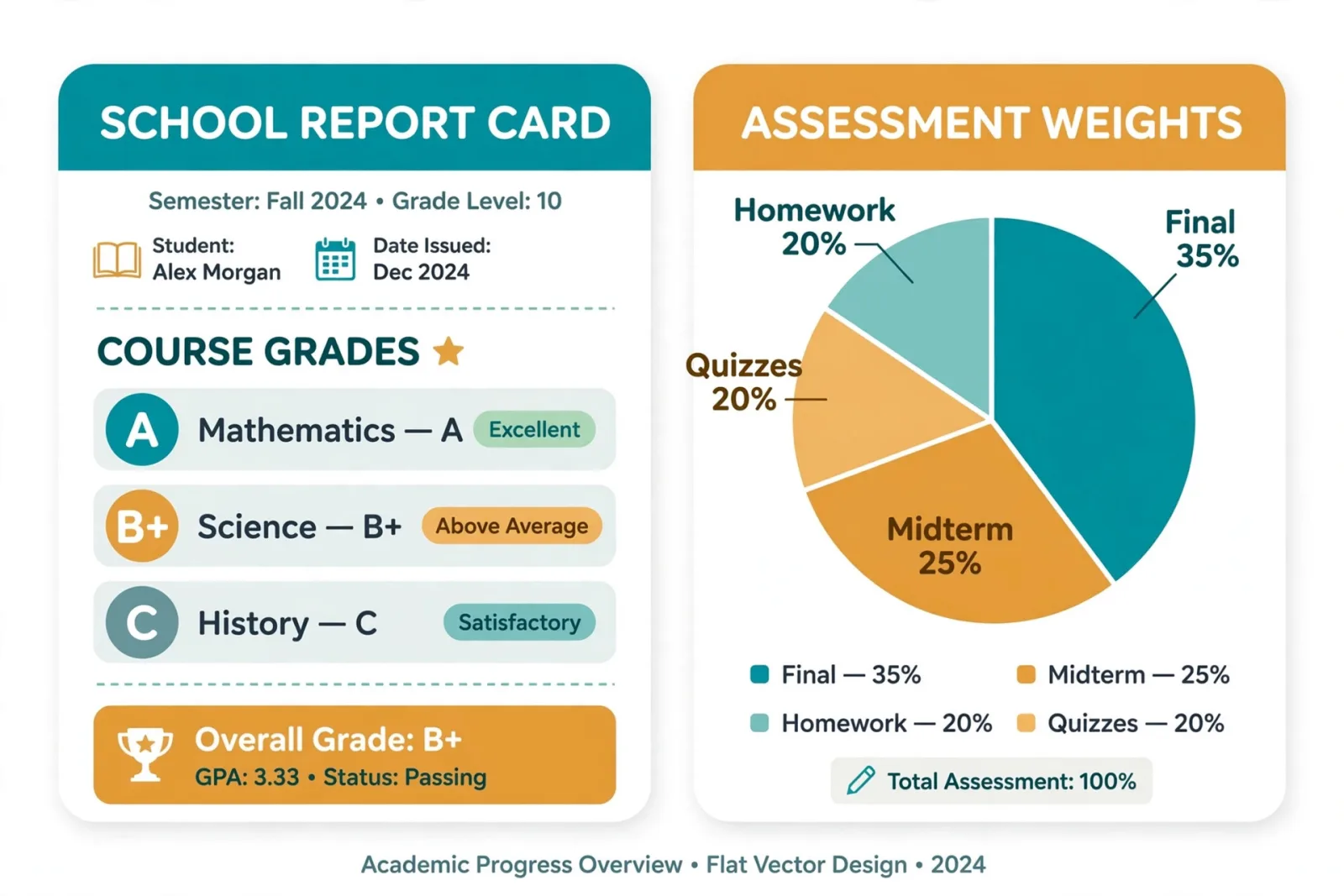
Multiply each category average by its weight as a decimal, then add the results. Example: homework 85% (weight 20%), quizzes 90% (20%), midterm 78% (25%), final 88% (35%) → 0.20 × 85 + 0.20 × 90 + 0.25 × 78 + 0.35 × 88 = 17 + 18 + 19.5 + 30.8 = 85.3%.
On this page
The Short Answer
This guide explains how to calculate grade averages when categories carry different weights. Most classes do not treat every assignment equally. Homework might count for 20% of your grade while the final exam counts for 35%, so a simple average of your scores would give the wrong answer. The correct method is a weighted average:
Final grade = (score₁ × weight₁) + (score₂ × weight₂) + … + (scoreₙ × weightₙ)
where each weight is the category's share of the total grade written as a decimal (20% → 0.20), and all weights add up to 1.00 (100%).
In the example above: 0.20 × 85 = 17, 0.20 × 90 = 18, 0.25 × 78 = 19.5, 0.35 × 88 = 30.8 — and 17 + 18 + 19.5 + 30.8 = 85.3%. Below you will find the formula worked out step by step so you can see how to calculate grade totals in any weighted class, plus how to figure out what you need on the final exam, how dropped scores and extra credit change the math, and the mistakes that cost students points.
The Weighted Grade Formula, Step by Step
Step 1 — Find each category's average. Average all the scores inside one category (homework, quizzes, exams, projects). For example, quiz scores of 80, 90, and 100 average to (80 + 90 + 100) ÷ 3 = 90.
Step 2 — Convert each weight to a decimal. Divide the percentage by 100. A category worth 25% becomes 0.25.
Step 3 — Multiply each average by its weight. A 90% quiz average in a 20% category contributes 0.20 × 90 = 18 points toward the final grade.
Step 4 — Add the contributions. The sum is your current grade. Double-check that the weights add to 1.00 (0.20 + 0.20 + 0.25 + 0.35 = 1.00) — if they do not, something is missing.
Worked Example: a Full Semester
Maya's syllabus breaks the grade into four categories:
| Category | Average | Weight | Weighted points |
|---|---|---|---|
| Homework | 85% | 20% | 0.20 × 85 = 17.0 |
| Quizzes | 90% | 20% | 0.20 × 90 = 18.0 |
| Midterm | 78% | 25% | 0.25 × 78 = 19.5 |
| Final exam | 88% | 35% | 0.35 × 88 = 30.8 |
Total: 85.3%. Check: 17.0 + 18.0 = 35.0; 35.0 + 19.5 = 54.5; 54.5 + 30.8 = 85.3. Maya finishes with a B. Notice how the midterm, despite being her lowest category, matters less than the final because of its smaller weight — that is exactly why weights exist.
What Do I Need on the Final?
Needed final score = (target grade − points already earned) ÷ final exam weight
Example: before the final, Daniel has earned these weighted points — homework 0.15 × 80 = 12, quizzes 0.15 × 75 = 11.25, midterm 0.30 × 70 = 21 — for 12 + 11.25 + 21 = 44.25 points out of the 60 available so far. The final is worth 40% (0.40).
- To finish with an 80%: (80 − 44.25) ÷ 0.40 = 35.75 ÷ 0.40 = 89.4% needed on the final. Tough but possible.
- To finish with a 90%: (90 − 44.25) ÷ 0.40 = 45.75 ÷ 0.40 = 114.4% — impossible without extra credit. That is useful information too: Daniel now knows an A is out of reach and can aim his effort accordingly.
Want to skip the arithmetic? Our grade calculator does the weighted math for you — enter your scores and weights to see your current grade and what you need on the final.
The Standard Grade Scale
US percentage → letter → GPA:
| Letter | Percentage | GPA |
|---|---|---|
| A | 93–100% | 4.0 |
| A− | 90–92% | 3.7 |
| B+ | 87–89% | 3.3 |
| B | 83–86% | 3.0 |
| B− | 80–82% | 2.7 |
| C+ | 77–79% | 2.3 |
| C | 73–76% | 2.0 |
| C− | 70–72% | 1.7 |
| D+ | 67–69% | 1.3 |
| D | 63–66% | 1.0 |
| D− | 60–62% | 0.7 |
| F | below 60% | 0.0 |
(Exact cutoffs vary by school — check your syllabus.) Term GPA = Σ(course GPA points × credit hours) ÷ Σ credit hours. A 3-credit A (12 points) plus a 4-credit B (12 points) = 24 ÷ 7 = 3.43 GPA.
Dropping the Lowest Score
Many teachers drop each student's lowest quiz or homework score: the dropped score leaves the category, and the category average is recomputed over the remaining scores. Example: quiz scores of 70, 85, 92, and 95. Without the drop: (70 + 85 + 92 + 95) ÷ 4 = 342 ÷ 4 = 85.5. With the 70 dropped: (85 + 92 + 95) ÷ 3 = 272 ÷ 3 = 90.67. That single policy lifts the quiz average by more than 5 points.
Extra Credit
Extra credit adds bonus points on top of a category or the final grade. If Maya (85.3% above) earns 2 percentage points of extra credit, her grade becomes 87.3% — crossing from a B into B+ territory. Note extra credit is usually capped: a syllabus may say grades cannot exceed 100%.
Straight Average vs Weighted Average
Using a plain average when you should use a weighted one is the most common grading mistake. Homework average 95% (weight 10%), exam average 70% (weight 60%), project 80% (weight 30%). Straight average: (95 + 70 + 80) ÷ 3 = 245 ÷ 3 = 81.67%. Weighted: 0.10 × 95 + 0.60 × 70 + 0.30 × 80 = 9.5 + 42 + 24 = 75.5%. The straight average overstates the grade by more than 6 points. Always use the weights from your syllabus.
Common Mistakes to Avoid
- Forgetting to convert percentages to decimals (85 × 20 = 1,700, not 17).
- Weights that do not add to 100% — ask the instructor, do not guess.
- Averaging letter grades directly — convert to percentages or GPA points first.
- Rounding too early — keep one decimal place and round only the final grade.
- Ignoring the syllabus — curves, dropped scores, and extra credit caps change the formula.
Quick Reference
- Weighted grade: Σ(average × weight) → 0.20×85 + 0.20×90 + 0.25×78 + 0.35×88 = 85.3%
- Needed on final: (target − earned) ÷ final weight → (80 − 44.25) ÷ 0.40 = 89.4%
- Category average: Σ scores ÷ count → (80+90+100) ÷ 3 = 90
- Term GPA: Σ(points × credits) ÷ Σ credits → (12+12) ÷ 7 = 3.43
- After dropping lowest: recompute average without it → (85+92+95) ÷ 3 = 90.67
Key Takeaways
- Final grade = Σ(category average × weight as a decimal) — weights must total 1.00.
- What you need on the final: (target − points earned) ÷ final weight.
- A straight average overstates your grade when high-weight categories are your weakest.
- Dropped scores and extra credit are recomputed into the category average — not free points on top unless the syllabus says so.
Frequently asked questions
How do you calculate your grade with weighted categories?
Multiply each category's average score by its weight as a decimal, then add all the results. Example: homework 85% at 20% weight contributes 0.20 × 85 = 17 points; do the same for every category and sum them.
What is the formula for calculating a final grade?
Final grade = (score₁ × weight₁) + (score₂ × weight₂) + … + (scoreₙ × weightₙ), with weights as decimals summing to 1.00. If a category is missing, the weights will not total 100% and the answer will be wrong.
How do I calculate what I need on my final exam?
Use (target grade − points already earned) ÷ final exam weight. If you have 44.25 of 60 points and the final is worth 40%, reaching 80% requires (80 − 44.25) ÷ 0.40 = 89.4% on the final.
How do you calculate GPA from letter grades?
Convert each letter to grade points (A = 4.0, B = 3.0, C = 2.0, D = 1.0, F = 0.0, with plus/minus steps of 0.3), multiply by the course's credit hours, sum, and divide by total credit hours.
Does dropping the lowest score really change my grade?
Yes. Quiz scores of 70, 85, 92, 95 average 85.5 with all four, but 90.67 after dropping the 70 — a gain of more than 5 points in that category.
Why is my grade lower than my plain average?
Because weights penalize weak performance in high-weight categories. A 70% exam average at 60% weight drags the grade down far more than a 95% homework average at 10% weight lifts it.
Related guides

How to Split Fair Teams in Seconds
Learn how to split fair teams fast: random draws, even and uneven groups, no-repeat rounds, and when to use a seeded…

Dice Probabilities Made Simple
Learn dice probabilities the easy way: one die, two dice, why 7 is most common, and how to use the odds in board games…

How to Make Fancy Text for Bios and Posts
Learn how to make fancy text for Instagram bios, WhatsApp, Discord and TikTok using Unicode styles — plus where fancy…

How to Improve Your Typing Speed (WPM)
Learn how to improve your typing speed with home-row technique, accuracy drills, and a 2-week practice plan. Real WPM…