How to Convert Time Units: Hours, Minutes & Seconds Explained
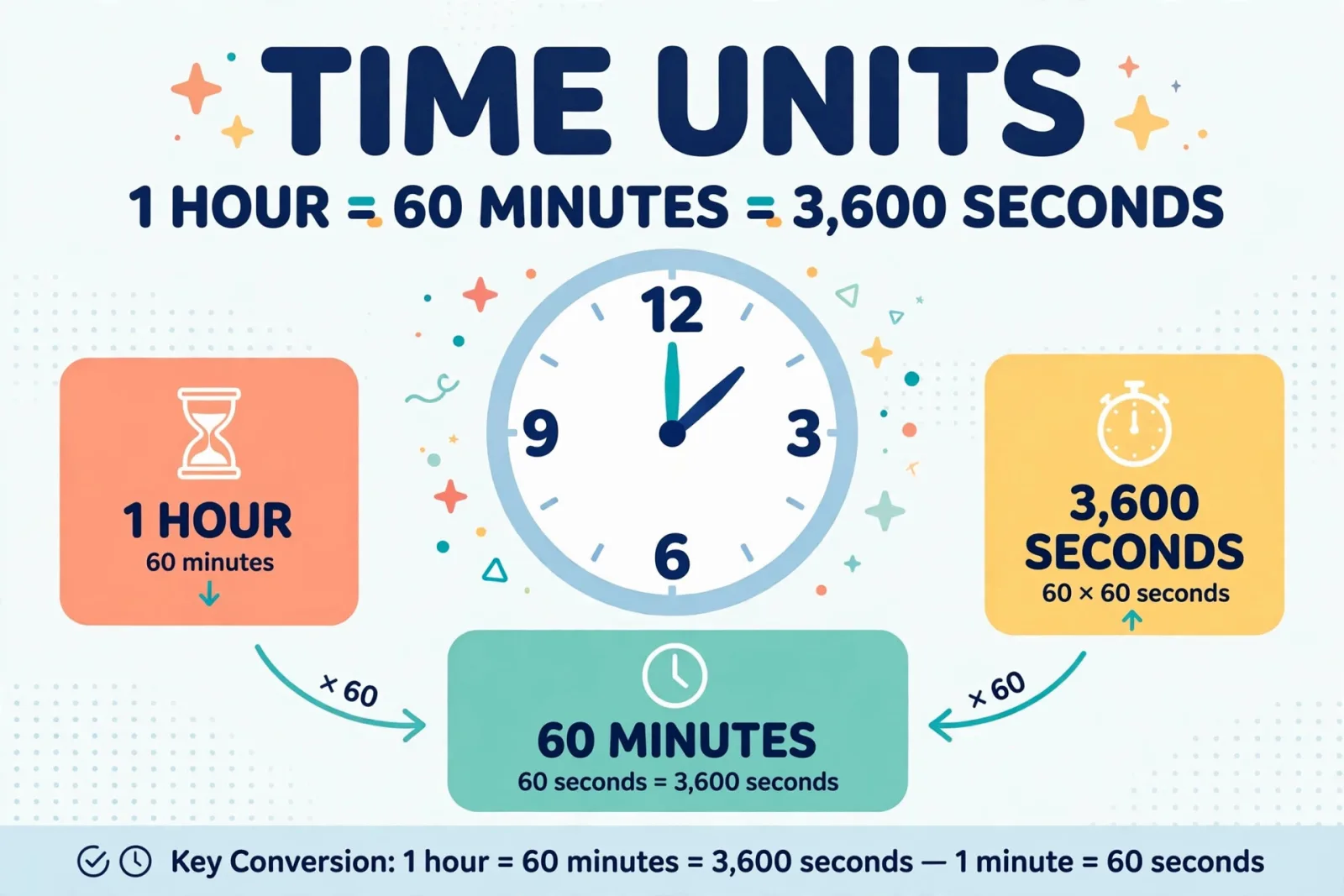
One hour equals 60 minutes, which equals 3,600 seconds. To convert time units, multiply when going from a bigger unit to a smaller one (hours to minutes: × 60) and divide when going from a smaller unit to a bigger one (minutes to hours: ÷ 60). For example, 150 minutes ÷ 60 = 2.5 hours, which is 2 hours 30 minutes.
On this page
The Time-Unit Ladder: From Milliseconds to Weeks
Every time conversion is a walk up or down a ladder of units, and each rung connects to the next by a fixed number. Learn the ladder once and you can convert any pair of units without memorizing dozens of separate formulas.
Starting from the smallest common unit and climbing up:
- 1 millisecond (ms) = one-thousandth of a second
- 1 second = 1,000 milliseconds
- 1 minute = 60 seconds = 60,000 milliseconds
- 1 hour = 60 minutes = 3,600 seconds
- 1 day = 24 hours = 1,440 minutes = 86,400 seconds
- 1 week = 7 days = 168 hours = 10,080 minutes = 604,800 seconds
Notice something unusual: most of the ladder multiplies by 60, but two rungs break the pattern — the day multiplies by 24 and the week by 7. That is exactly why time conversion feels harder than metric conversions, where every step is ×10. There is no ×10 safety net here; you just need to know which multiplier each rung uses.
Why 60? The 60-based system comes from ancient Babylonian mathematics, which used a base-60 (sexagesimal) number system, and the convention survived through thousands of years of clockmaking. We inherited it — so we might as well master it.
One honest caution: months and years are not fixed rungs. A month is 28, 29, 30, or 31 days, and a year is 365 or 366 days, so converting days to months is always an approximation. This guide sticks to exact conversions only.
The One Rule: Multiply Down, Divide Up
You do not need a formula sheet — one rule covers everything:
- Going from a bigger unit to a smaller one (hours → minutes): multiply. Bigger units hold more of the smaller ones, so the number gets bigger.
- Going from a smaller unit to a bigger one (minutes → hours): divide. It takes many small units to make one big one, so the number gets smaller.
The multiplier is simply the number of small units inside one big unit. Here is the complete reference table:
| Conversion | Operation | Example |
|---|---|---|
| Hours → minutes | × 60 | 3.5 h × 60 = 210 min |
| Minutes → hours | ÷ 60 | 150 min ÷ 60 = 2.5 h |
| Minutes → seconds | × 60 | 45 min × 60 = 2,700 s |
| Seconds → minutes | ÷ 60 | 300 s ÷ 60 = 5 min |
| Hours → seconds | × 3,600 | 2.5 h × 3,600 = 9,000 s |
| Seconds → hours | ÷ 3,600 | 9,000 s ÷ 3,600 = 2.5 h |
| Days → hours | × 24 | 2 days × 24 = 48 h |
| Hours → days | ÷ 24 | 36 h ÷ 24 = 1.5 days |
| Days → minutes | × 1,440 | 2 days × 1,440 = 2,880 min |
| Minutes → days | ÷ 1,440 | 2,880 min ÷ 1,440 = 2 days |
| Weeks → days | × 7 | 3 weeks × 7 = 21 days |
| Days → weeks | ÷ 7 | 21 days ÷ 7 = 3 weeks |
| Seconds → milliseconds | × 1,000 | 5 s × 1,000 = 5,000 ms |
| Milliseconds → seconds | ÷ 1,000 | 2,500 ms ÷ 1,000 = 2.5 s |
A handy shortcut: when skipping a rung (for example, hours straight to seconds), multiply the rungs together — 60 × 60 = 3,600. That is where the 3,600 in the hours-to-seconds row comes from.
If a result feels wrong, sanity-check it with the rule: did your number grow when you went smaller, and shrink when you went bigger? If not, you mixed up multiply and divide.
Hours, Minutes and Seconds: Worked Examples Both Directions
These are the conversions people look up most often. Each example shows the setup, the arithmetic, and the answer — in both directions, so you see the rule working either way.
Example 1: 3.5 hours → minutes
The director says a meeting lasts 3.5 hours. How many minutes is that? Hours are bigger than minutes, so multiply: 3.5 × 60 = 210 minutes. Setup check: 3.5 × 60 = (3 × 60) + (0.5 × 60) = 180 + 30 = 210. ✓
Example 2: 150 minutes → hours
A movie runtime is listed as 150 minutes. Divide by 60 because you are going up to a bigger unit: 150 ÷ 60 = 2.5 hours, which reads as 2 hours 30 minutes. The decimal part 0.5 × 60 = 30 minutes — never read ".5 hours" as 50 minutes (see the mistakes section below).
Example 3: 2.5 hours → seconds
Sports timing often lands in seconds. Going from hours down two rungs: 2.5 × 3,600 = 9,000 seconds. You can also do it rung by rung — 2.5 × 60 = 150 minutes, then 150 × 60 = 9,000 seconds. Both paths agree.
Example 4: 9,000 seconds → hours
Reverse it: 9,000 ÷ 3,600 = 2.5 hours. Cross-check against Example 3: converting back and forth returns you to the starting value, which is the fastest way to verify any conversion.
Converting Days, Weeks and Larger Jumps
The day and week rungs are where people hesitate, because the multipliers change from 60 to 24 and 7. But the same rule applies — only the number changes.
Example 5: 2 days → hours, and 36 hours → days
A 2-day weekend trip is 2 × 24 = 48 hours. Reverse: a 36-hour work trip is 36 ÷ 24 = 1.5 days, or 1 day 12 hours (0.5 × 24 = 12).
Example 6: 2,880 minutes → days
A project deadline is "2,880 minutes from now." Minutes to days means dividing up two rungs: 2,880 ÷ 1,440 = 2 days. (You can also divide by 60 to get 48 hours first, then divide by 24 — same answer.)
Example 7: Weeks to seconds
How many seconds are in a full week? Climb every rung downward: 7 days × 24 = 168 hours; 168 × 60 = 10,080 minutes; 10,080 × 60 = 604,800 seconds. That number is worth knowing by heart if you ever schedule weekly recurring jobs or calculate server uptime.
Decimal Hours vs. Hours and Minutes
Timesheets, payroll systems, and billing software almost always use decimal hours — 2.75 h, 1.5 h — while humans speak in hours and minutes. Converting between the two is one of the most practical time skills there is.
Decimal hours → hours and minutes: keep the whole number as the hours, then multiply the decimal part by 60. For 2.75 hours: 0.75 × 60 = 45, so 2.75 h = 2 hours 45 minutes. For 1.25 h: 0.25 × 60 = 15, so 1.25 h = 1 hour 15 minutes.
Hours and minutes → decimal hours: divide the minutes by 60 and add. For 1 hour 20 minutes: 20 ÷ 60 ≈ 0.333, so the answer is ≈ 1.33 hours. For 2 hours 30 minutes: 30 ÷ 60 = 0.5, giving exactly 2.5 hours.
A useful benchmark: 0.1 hours is 6 minutes (0.1 × 60 = 6), so payroll "tenths of an hour" are really 6-minute blocks. And 1.5 hours is 1 hour 30 minutes — the decimal half means half of 60, never 50 minutes.
If these conversions feel tedious by hand, our free time converter switches between decimal hours and hours:minutes instantly.
Adding and Subtracting Time Durations
Durations add and subtract like ordinary numbers as long as you convert to the smallest unit first, then convert back.
Adding: total flight time is 1 h 45 min plus a 2 h 30 min layover. Convert both to minutes: 105 + 150 = 255 minutes. Convert back: 255 ÷ 60 = 4.25 hours = 4 hours 15 minutes (255 = 4 × 60 + 15).
Subtracting: a 3 h 20 min shift ends 1 h 50 min early — how long did you work? Convert to minutes: 200 − 110 = 90 minutes = 1 hour 30 minutes.
The "borrow" shortcut for subtraction works like elementary-school borrowing, except you borrow 60 instead of 10: 3 h 20 min − 1 h 50 min. The 20 minutes cannot cover 50, so borrow 1 hour (60 minutes): 2 h 80 min − 1 h 50 min = 1 h 30 min. Same answer, no full conversion needed.
5 Common Mistakes to Avoid
- Reading 1.5 hours as 1 hour 50 minutes. It is 1 hour 30 minutes. The decimal half is half of 60 minutes, not 50. This single mistake causes more timesheet disputes than any other.
- Multiplying minutes by 1,000 for milliseconds. One minute is 60,000 ms (60 × 1,000), not 1,000 — you skipped the seconds rung. Always convert step by step or multiply the rungs together.
- Using × 60 between days and hours. A day is 24 hours, not 60. The 60-multiplier stops at the hour rung; after that it is 24, then 7.
- Forgetting that days have 1,440 minutes. When a countdown says "1,440 minutes left," that is exactly one day — a fact worth recognizing instantly in scheduling apps.
- Treating months and years as exact. 30 days is a fine estimate for a month, but do not build precise conversions on it — February alone breaks the math, and leap years add a 366th day.
Time Conversions in Everyday Life
- Work hours: a 40-hour work week is 40 × 60 = 2,400 minutes. An 8-hour shift is 8 × 60 = 480 minutes.
- Cooking: a recipe that bakes for 45 minutes needs 45 × 60 = 2,700 seconds on a lab timer that only accepts seconds.
- Travel: a 2 h 15 min flight is 2 × 60 + 15 = 135 minutes of seat time — useful for estimating fuel, snacks, and battery life.
- Sports: the men's marathon world record of 2:02:57 is 2 × 3,600 + 2 × 60 + 57 = 7,377 seconds, or 7,377 ÷ 60 ≈ 122.95 minutes. Timing systems record in seconds; broadcasts convert back up the ladder.
Frequently asked questions
How many seconds are in an hour?
3,600 seconds. Multiply the 60 minutes in an hour by the 60 seconds in each minute: 60 × 60 = 3,600.
How do you convert minutes to hours?
Divide minutes by 60. For example, 90 minutes ÷ 60 = 1.5 hours (1 hour 30 minutes). To convert hours to minutes, do the reverse and multiply by 60: 2 hours × 60 = 120 minutes.
What is 2.5 hours in hours and minutes?
2 hours 30 minutes. Multiply the decimal part by 60: 0.5 × 60 = 30 minutes. Similarly, 2.75 hours is 2 hours 45 minutes (0.75 × 60 = 45).
How many minutes are in a day?
1,440 minutes: 24 hours × 60 minutes. And there are 86,400 seconds in a day (1,440 × 60).
Why do we use 60 instead of 100 for time?
Time inherited a base-60 (sexagesimal) system from ancient Babylonian mathematics, thousands of years before decimal measurement existed. Clocks, calendars, and angles (360 degrees) all keep the convention today, which is why the hour breaks into 60 minutes instead of 100.
Can I convert months to days exactly?
No — months are not a fixed unit. They run 28 to 31 days, and leap years add a 29th day to February. Use 30 days per month only as a rough estimate, never for precise conversions.
Related guides

How to Split Fair Teams in Seconds
Learn how to split fair teams fast: random draws, even and uneven groups, no-repeat rounds, and when to use a seeded…

Dice Probabilities Made Simple
Learn dice probabilities the easy way: one die, two dice, why 7 is most common, and how to use the odds in board games…

How to Make Fancy Text for Bios and Posts
Learn how to make fancy text for Instagram bios, WhatsApp, Discord and TikTok using Unicode styles — plus where fancy…

How to Improve Your Typing Speed (WPM)
Learn how to improve your typing speed with home-row technique, accuracy drills, and a 2-week practice plan. Real WPM…