How to Round Numbers: Rules for Rounding Up and Down
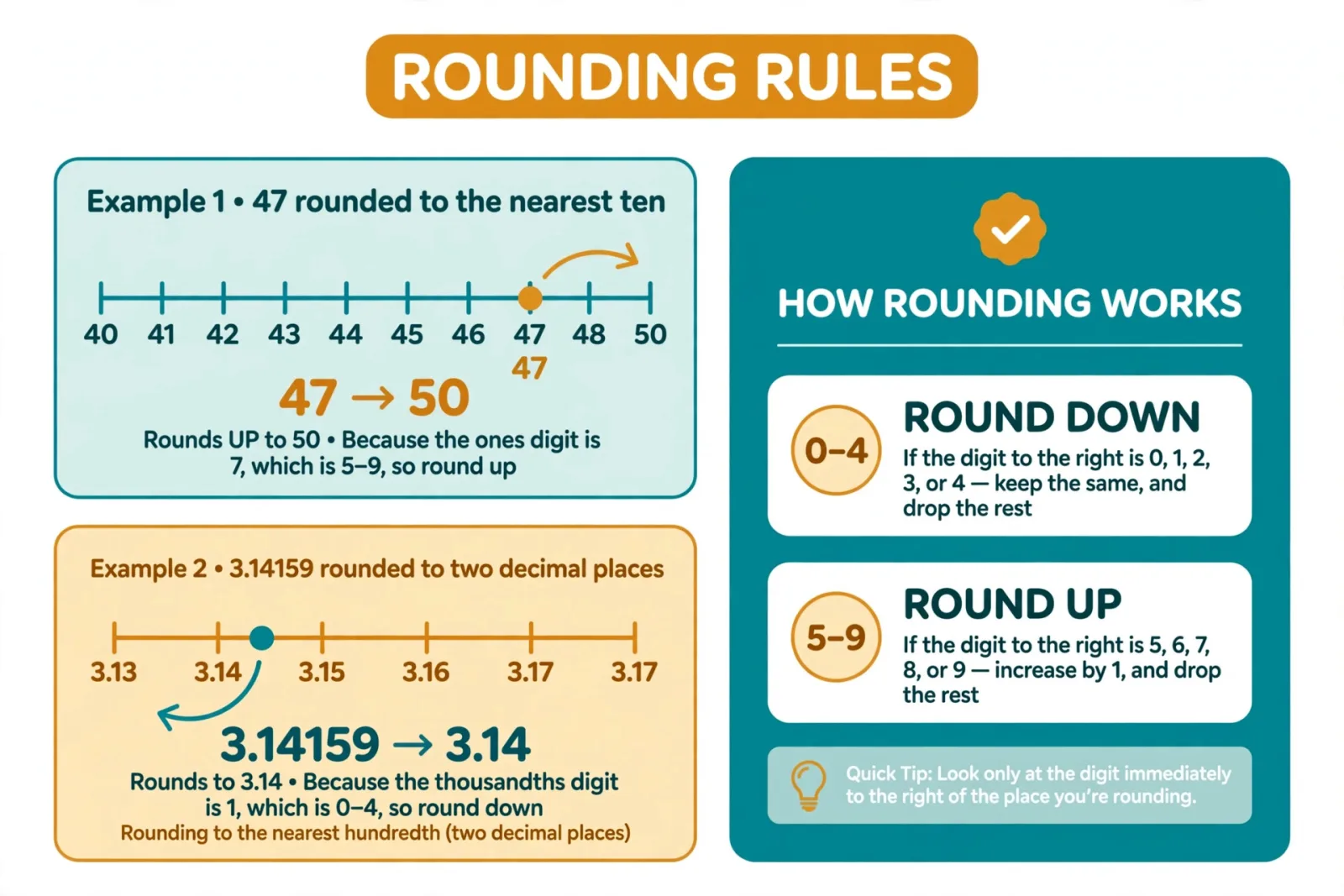
**To round a number, look at the digit to the right of your rounding place: if it is 5 or more, round up; if it is 4 or less, round down.** For decimals, 2.5 rounds up to 3 (round half up), and for money always keep two decimal places — $4.995 becomes $5.00.
### What is rounding, and why do we do it? Rounding means replacing a number with a simpler, nearby value that is easier to work with. Nobody says "this jar of pasta sauce costs $4.97 and I have $20.13, so I can buy 4.03 jars" — you round to $5 and think "I can buy 4". Rounding trades a tiny amount of precision for numbers your brain can actually use. We round numbers constantly in real life: - **Shopping:** $47.49 becomes "about $47" or "about $50" when budgeting. - **Distances and times:** a 2,847-mile road trip becomes "about 2,800 miles"; a 96-minute movie is "about an hour and a half". - **Statistics:** a city of 6,472,310 people is reported as "about 6.5 million". - **Money:** bills are always settled to the exact cent, which is itself a rounding operation. The key insight: rounding never changes the *size category* of a number. 47 rounded to 50 is still "around fifty". The rule below tells you which of the two nearby candidates to pick. ### Place-value refresher Before you can round, you need to name the digit you are rounding *to*. Place value gives every digit a position: | Position | Value | Example in 4,872.351 | |---|---|---| | Thousands | 1,000s | 4 | | Hundreds | 100s | 8 | | Tens | 10s | 7 | | Ones | 1s | 2 | | Tenths | 0.1s | 3 | | Hundredths | 0.01s | 5 | | Thousandths | 0.001s | 1 | Whole numbers live to the left of the decimal point (ones, tens, hundreds); fractions of a whole live to the right (tenths, hundredths, thousandths). When someone says "round to the nearest hundred", the hundreds digit is your **rounding digit**, and the digit immediately to its right is the **decision digit** — the one that decides up or down. ### The core rule: rounding to the nearest ten, hundred, or thousand This one rule covers all whole-number rounding: 1. **Find the rounding digit** — the digit in the place you are rounding to. 2. **Look at the decision digit** — the digit immediately to its right. 3. **Decision digit 5 or more → round the rounding digit UP by one**, and turn everything to its right into zeros. 4. **Decision digit 4 or less → keep the rounding digit as is**, and turn everything to its right into zeros. **Worked example — 47 to the nearest ten:** The rounding digit is 4 (the tens place); the decision digit is 7 (the ones place). 7 is 5 or more, so round up: 4 → 5, and the ones place becomes 0 → **50**. **Worked example — 1,483 to the nearest hundred:** The rounding digit is 4 (hundreds); the decision digit is 8 (tens). 8 ≥ 5, so round up: 4 → 5, and everything right becomes 00 → **1,500**. **Worked example — 6,472 to the nearest thousand:** The rounding digit is 6 (thousands); the decision digit is 4 (hundreds). 4 ≤ 4, so the 6 stays, and the rest becomes 000 → **6,000**. Note that rounding up can cascade: 1,950 to the nearest hundred rounds up because the decision digit is 5 → 1,9→(9+1) → **2,000**. That is correct, not a mistake — the carried digit propagates left. ### Rounding decimals to 1, 2, or 3 decimal places The same rule works for decimals — only the "zeros" become dropped digits instead of added zeros: 1. Keep digits up to your rounding place. 2. Look at the next digit to the right. 3. **5 or more → round up** the last kept digit; **4 or less → leave it**, and drop everything after. **Worked example — 3.14159 to 2 decimal places:** Keep 3.14; the decision digit is the third decimal, 1. 1 ≤ 4, so leave the 4 alone → **3.14**. **Worked example — 2.348 to 2 decimal places:** Keep 2.34; the decision digit is 8. 8 ≥ 5, so round up: 2.34 → **2.35**. **Worked example — 7.8561 to 1 decimal place:** Keep 7.8; the decision digit is 5. 5 ≥ 5, so round up: 7.8 → **7.9**. ### The .5 rule: round half up What happens when the decision digit is exactly 5, like rounding 2.5 to the nearest whole number? The school and everyday convention is **round half up**: a tie always rounds *away* from zero. - 2.5 → **3** - 3.5 → **4** - 1.45 to 1 decimal place → the decision digit is exactly 5 → **1.5** Why "up" and not "down"? Because a coin-flip tie has to go somewhere, and consistently sending it upward keeps the rule simple and memorable. All the examples in this guide use round half up — it is the standard taught in schools worldwide and the default in most spreadsheets and calculators. ### Banker's rounding: round half to even (a brief note) There is one alternative worth knowing about, because you may meet it in finance or statistics software: **round half to even**, also called banker's rounding. Ties round to the nearest *even* digit instead of always up: - 2.5 → **2** (2 is even) - 3.5 → **4** (4 is even) Why does this exist? If you always round .5 up, thousands of small ties add a tiny upward bias — bad when a bank processes millions of transactions. Rounding half to even sends ties up and down in roughly equal numbers, cancelling the bias. Python's built-in `round()` uses this method, which surprises many beginners — but for schoolwork, shopping, and daily life, **round half up** is the rule you want. ### Rounding up vs. rounding down: ceiling and floor Sometimes you do not round to the *nearest* value — you deliberately always go up or always go down. These have formal names: - **Ceiling (round up):** always to the next value up, even for a tiny fraction. Ceiling(3.02) = **4**. Used when you need *enough*: a trip of 3.02 cars' worth of people needs 4 cars. - **Floor (round down):** always to the next value down. Floor(3.98) = **3**. Used when you need *complete units*: 3.98 items per box fills 3 full boxes. **Worked example — party snacks:** 8 friends each eat 2.4 slices of pizza, so you need 19.2 slices. Nearest is 19, but you cannot buy 0.2 of a slice — you must round **up** (ceiling): 19.2 → **20 slices**, i.e., 3 whole pizzas. ### Rounding money to cents Money is rounded to two decimal places — the nearest cent. Apply the standard rule: **Worked example — $4.995 → $5.00:** Keep $4.99; the decision digit is the third decimal, 5. 5 ≥ 5, so round up: $4.99 + $0.01 = **$5.00**. Notice the trailing zero is kept — $5.00, not $5 — because it signals cents-precision. **Worked example — $2.344 → $2.34:** Keep $2.34; the decision digit is 4. 4 ≤ 4 → **$2.34**. **Worked example — 0.045 to 2 decimal places → 0.05:** Keep 0.04; the decision digit is 5 → round up → **0.05**. Half a cent rounds up to a full cent. A register-ready rule of thumb: prices ending in .x95 or higher at the third decimal tick up to the next cent. ### Common mistakes to avoid **1. Rounding twice (cascading errors).** Never round in stages. Rounding 2.45 to 1 decimal place gives 2.5 (half up), and rounding 2.5 to a whole number gives 3 — but rounding 2.45 directly to a whole number gives **2** (decision digit 4). The staged version gave 3; the correct answer is 2. **Always round from the original number, never from an already-rounded one.** **2. Confusing "nearest hundred" with "hundredths".** "Nearest hundred" rounds whole numbers (1,483 → 1,500); "hundredths" rounds decimals to two decimal places (3.148 → 3.15). The words sound alike but live on opposite sides of the decimal point. **3. Dropping trailing zeros in money.** $4.995 rounds to **$5.00**, not $5. The trailing zero carries meaning: it tells the reader the figure is exact to the cent. In general, keep as many digits as your rounding place demands — 3.140 to 2 decimals stays 3.140 in scientific contexts for the same reason. **4. Rounding before the final step.** In multi-step calculations, rounding intermediate results multiplies the error. Compute with full precision and round only the final answer. 3.14159 × 2 = 6.28318 → **6.28** is more accurate than rounding 3.14159 to 3.14 first (3.14 × 2 = 6.28 happens to agree here, but with longer chains the errors compound). **5. Forgetting the .5 goes UP (in school math).** 2.5 → **3**, not 2. The most common test error is rounding .5 down. (The only exception is specialized banker's rounding, covered above.) ### Rounding-rules summary table | What you want | Look at | 5 or more → | 4 or less → | Example | |---|---|---|---| | Nearest ten | Ones digit | Round up, ones → 0 | Keep, ones → 0 | 47 → **50** | | Nearest hundred | Tens digit | Round up, last two → 00 | Keep, last two → 00 | 1,483 → **1,500** | | Nearest thousand | Hundreds digit | Round up, last three → 000 | Keep, last three → 000 | 6,472 → **6,000** | | 1 decimal place | 2nd decimal | Round up last kept digit | Keep last kept digit | 7.856 → **7.9** | | 2 decimal places | 3rd decimal | Round up last kept digit | Keep last kept digit | 3.14159 → **3.14** | | Money (cents) | 3rd decimal | Round up to next cent | Keep cents | $4.995 → **$5.00** | | Ceiling (always up) | Any fraction | Next value up | Next value up | 3.02 → **4** | | Floor (always down) | Any fraction | Next value down | Next value down | 3.98 → **3** | ### Key takeaways - **The one rule:** look at the digit right of your rounding place — **5+ rounds up, 4 or less rounds down.** Everything else is detail. - **Whole numbers** turn trailing digits to zeros: 47 → 50, 1,483 → 1,500, 6,472 → 6,000. - **Decimals** drop the extra digits: 3.14159 → 3.14 (2 places), 2.348 → 2.35. - **A tie (.5) rounds up** in school and everyday math: 2.5 → 3. Banker's rounding (to even) exists only in specialized finance/statistics contexts. - **Money keeps two decimals:** $4.995 → $5.00 — never drop the trailing zero. - **Round only once, from the original number** — staged rounding is the #1 source of errors. - Check any rounding instantly with our free [rounding calculator](/rounding-calculator/).
Frequently asked questions
How do you round numbers to the nearest ten?
Look at the ones digit: if it is 5 or more, round the tens digit up; if 4 or less, keep the tens digit. For 47, the ones digit 7 is ≥ 5, so round up: 47 → 50. For 42, the ones digit 2 is ≤ 4, so it stays: 42 → 40.
What are the rules for rounding up and down?
Find the digit in the place you are rounding to, then check the digit immediately to its right. A decision digit of 5, 6, 7, 8, or 9 rounds the rounding digit up (1,483 → 1,500); a decision digit of 0–4 leaves it unchanged (6,472 → 6,000). For decimals, the rounded-off digits are dropped rather than zeroed: 3.14159 → 3.14 to two places.
What does 2.5 round to?
2.5 rounds to 3. This is the round-half-up rule: an exact .5 tie rounds up, the standard taught in schools and used in everyday math. The only common exception is banker's rounding (round half to even), used in some financial software, where 2.5 rounds to 2 — but for schoolwork and daily life, 2.5 → 3 is the answer.
How do you round 3.14159 to 2 decimal places?
Keep two digits after the decimal (3.14) and look at the third decimal, which is 1. Since 1 ≤ 4, leave the 4 alone and drop the rest → 3.14. Worked check: 3.14159 → kept digits "3.14", decision digit "1", 1 < 5 → 3.14. If the third decimal had been 5 or more, you would round the 4 up to 5 (e.g., 3.146 → 3.15).
How do you round money to the nearest cent?
Round to two decimal places using the standard rule, and always keep both decimals: $4.995 → $5.00, $2.344 → $2.34. The trailing zero matters — $5.00 signals exactness to the cent. Note that 0.045 rounds to $0.05, since the third decimal 5 triggers a round-up.
What is the difference between rounding, ceiling, and floor?
Rounding goes to the nearest value (3.02 → 3, 3.98 → 4); ceiling always goes up (3.02 → 4); floor always goes down (3.98 → 3). Use ceiling when you need enough of something (3.02 carloads of people need 4 cars) and floor when you need complete units (3.98 boxes' worth fills 3 full boxes).
Related guides

How to Split Fair Teams in Seconds
Learn how to split fair teams fast: random draws, even and uneven groups, no-repeat rounds, and when to use a seeded…
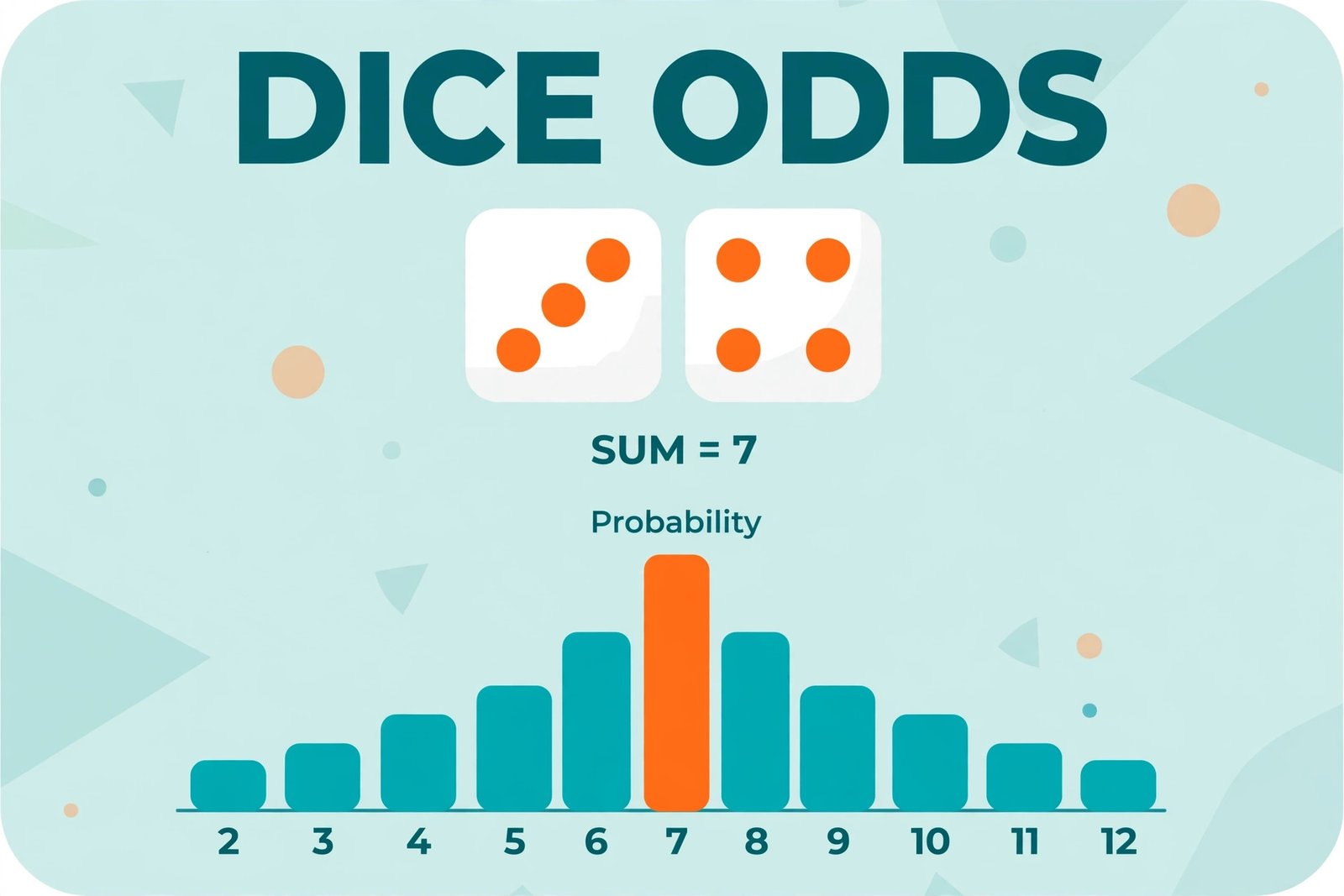
Dice Probabilities Made Simple
Learn dice probabilities the easy way: one die, two dice, why 7 is most common, and how to use the odds in board games…

How to Make Fancy Text for Bios and Posts
Learn how to make fancy text for Instagram bios, WhatsApp, Discord and TikTok using Unicode styles — plus where fancy…

How to Improve Your Typing Speed (WPM)
Learn how to improve your typing speed with home-row technique, accuracy drills, and a 2-week practice plan. Real WPM…